
Encumbrance Certificate (EC) Explained – Complete Guide for Plot Buyers in Vizag (2026)
Introduction
Buying a plot is one of the biggest financial decisions most people make. Whether you are purchasing a residential plot to build your dream home or investing in VMRDA Approved Plots in Vizag, ensuring that the property is legally clear is just as important as choosing the right location.
Many buyers focus on price, location, road access, or future appreciation but overlook one of the most important legal documents—the Encumbrance Certificate (EC).
An attractive plot near Bhogapuram International Airport, Anandapuram, Bheemili, Kothavalasa, Atchutapuram, or other fast-growing areas around Visakhapatnam may appear to be a great investment. However, if the land has an undisclosed loan, court attachment, or previous legal transaction, your investment could become complicated.
This is why experienced property buyers, banks, and legal professionals always recommend verifying the Encumbrance Certificate before purchasing any land.
At VizagPropertys, we specialize in VMRDA Approved Plots in Vizag and believe that an informed buyer is a confident buyer. This guide explains everything you need to know about an Encumbrance Certificate in simple language, helping you understand why it is important, how it works, and how it protects your investment.
Whether you are a first-time buyer, an investor, an NRI, or planning to purchase land for future construction, this guide will help you make a safer property investment.
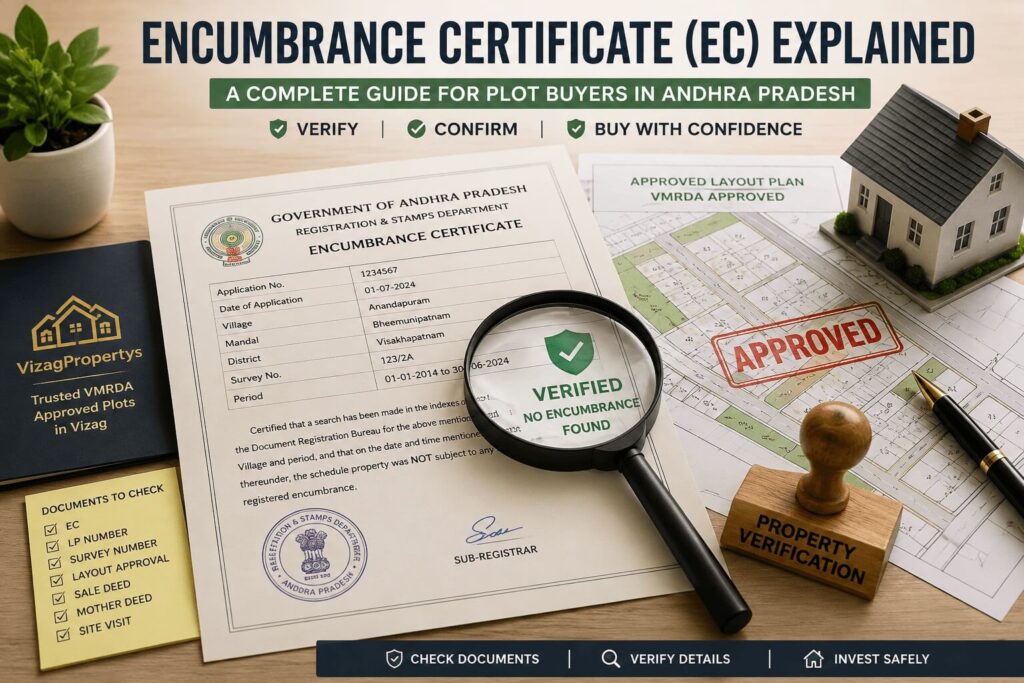
What is an Encumbrance Certificate (EC)?
An Encumbrance Certificate (EC) is an official document issued by the Registration Department that records the registered financial and legal transactions associated with a property during a specified period.
In simple words, an EC helps you understand whether a property has been involved in registered transactions such as:
- Sale of the property
- Gift deeds
- Mortgage registrations
- Property transfers
- Lease registrations (where applicable)
- Release deeds
- Settlement deeds
If the property has been used as security for a registered loan or has undergone registered ownership changes, these transactions generally appear in the Encumbrance Certificate for the selected period.
Because of this, the EC is considered one of the most important documents when verifying a plot before purchase.
Important: An Encumbrance Certificate reflects registered transactions available in the registration records for the selected period. It should be used together with other legal documents during property verification.
Why is an Encumbrance Certificate Important?
Imagine you find a beautiful plot at an attractive price near Bhogapuram Airport.
The seller tells you:
- The plot is genuine.
- The title is clear.
- There are no loans.
- Registration can be completed immediately.
Everything sounds perfect.
But after purchasing the plot, you discover that the property had previously been mortgaged through a registered transaction or that there are ownership-related issues requiring further verification.
Situations like these can lead to unnecessary delays, legal complications, or financial losses.
Checking the Encumbrance Certificate before purchasing significantly reduces the chances of such surprises and helps buyers make better-informed decisions.
Why Every Plot Buyer Should Check an EC
Whether you are buying:
- A residential plot
- An investment plot
- A retirement property
- A future home site
- A commercial plot
checking the Encumbrance Certificate should always be part of your verification process.
An EC helps buyers:
- Verify recorded ownership transactions.
- Understand whether registered mortgages exist during the selected period.
- Review the chain of registered transactions.
- Support bank loan processing when required.
- Improve confidence before property registration.
For anyone planning to purchase VMRDA Approved Plots in Vizag, checking the EC is an important step in legal due diligence.
A Simple Real-Life Example
Consider two buyers.
Buyer A
He likes a plot because:
- It has a wide road.
- The price is attractive.
- It is close to the upcoming Bhogapuram Airport.
Without verifying the documents, he immediately pays an advance.
Later, he discovers that the property records require additional legal verification, delaying the transaction.
Buyer B
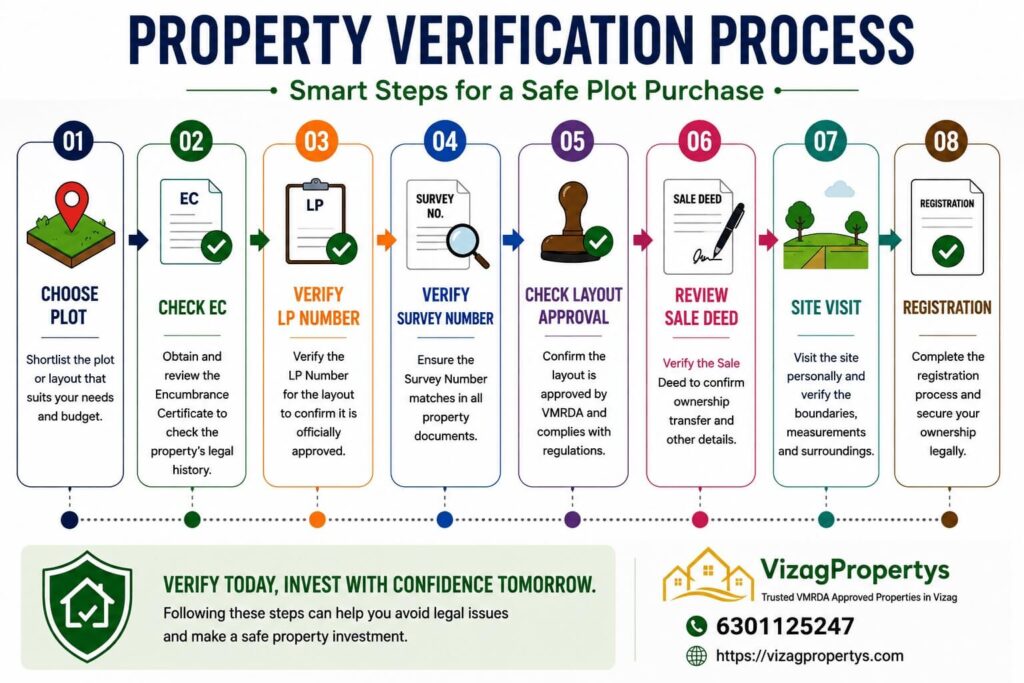
Before paying any advance, she verifies:
- Encumbrance Certificate
- LP Number
- Survey Number
- Layout Approval
- Sale Deed
- Title documents
Only after completing these checks does she proceed with the purchase.
Buyer B greatly reduces the risk of unexpected legal issues because she performed proper due diligence.
This example illustrates why experienced buyers spend time verifying documents before investing in land.
How Does an EC Protect Plot Buyers?
An Encumbrance Certificate provides valuable information about registered property transactions.
It can help buyers:
- Review registered ownership transfers.
- Identify registered mortgages within the selected search period.
- Verify that property transactions have been officially recorded.
- Support discussions with legal advisors before registration.
- Build greater confidence before making a large investment.
Although an EC is a vital document, it should never be treated as the only document required for verification.
Why Banks Ask for an EC
If you are applying for a loan to purchase a plot, banks usually require several legal documents as part of their assessment.
An Encumbrance Certificate is commonly requested because it helps the bank review the property’s registered transaction history during the selected period.
However, banks typically examine multiple documents—not just the EC—before approving a loan.
Common Misconceptions About an EC
Many buyers believe:
❌ “If I have the EC, I don’t need any other documents.”
This is incorrect.
Others think:
❌ “An EC guarantees that the property has absolutely no legal issues.”
This is also incorrect.
An Encumbrance Certificate is an important document, but it forms only one part of a complete property verification process.
You should also verify documents such as:
- LP Number
- Survey Number
- Layout Approval
- Sale Deed
- Mother Deed
- Title documents
- Property tax records
- Physical site boundaries
We will explain each of these in later sections of this guide.
Expert Tip
Never purchase a plot based only on verbal assurances from the seller.
Always verify the property’s legal documents before paying an advance. Spending a little time on document verification can help prevent expensive mistakes later.
Why This Matters Even More in Fast-Growing Areas
Areas surrounding Bhogapuram, Anandapuram, Bheemili, Atchutapuram, Kothavalasa, Vizianagaram, and other growth corridors near Visakhapatnam are attracting increasing interest from homebuyers and investors.
As demand rises, buyers should focus not only on location and future appreciation but also on proper legal verification.
If you are considering Plots in Vizag or VMRDA Approved Plots in Vizag, checking the Encumbrance Certificate should be a standard part of your buying process.
Choosing a legally verified plot provides greater confidence and supports a smoother registration process.
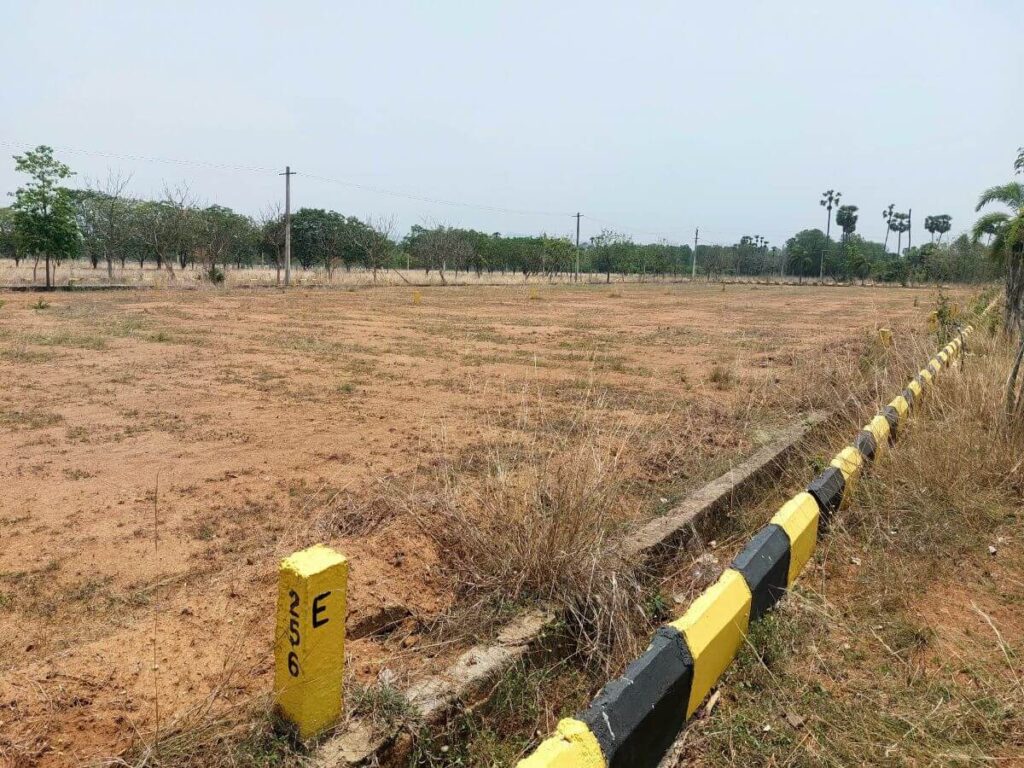
Need Help Verifying Plot Documents?
Buying land involves much more than selecting the right location.
Understanding documents such as the Encumbrance Certificate, LP Number, Survey Number, and Layout Approval can make a significant difference when evaluating a property.
If you’re planning to purchase VMRDA Approved Plots in Vizag and would like guidance on understanding plot documents, the team at VizagPropertys can help you better understand the verification process before you make an investment.
What Information Does an Encumbrance Certificate (EC) Contain?
An Encumbrance Certificate (EC) provides details of registered transactions relating to a property during the period you select. It acts as a historical record maintained by the Registration Department and helps buyers understand whether the property has undergone registered ownership changes or other registered transactions.
For anyone planning to purchase VMRDA Approved Plots in Vizag, checking these records is an important step before paying an advance or completing registration.
A typical Encumbrance Certificate may include the following information.
Property Description
The EC usually contains basic details that help identify the property, such as:
- Survey Number
- Sub-Division Number (if applicable)
- Village
- Mandal
- District
- Property description
- Extent of land
Always verify that these details match the documents provided by the seller.
Registered Sale Transactions
If the property has been sold through a registered Sale Deed during the selected search period, the EC generally records:
- Date of registration
- Document number
- Registration office
- Name of the buyer
- Name of the seller
- Nature of the transaction
This helps buyers understand the chain of registered ownership.
Registered Mortgage Details
If the owner created a registered mortgage with a bank or financial institution, it may appear in the Encumbrance Certificate.
This is one of the main reasons banks and experienced property buyers insist on checking an EC before purchasing land.
Gift, Settlement and Release Deeds
The EC may also include registered transactions such as:
- Gift Deeds
- Settlement Deeds
- Release Deeds
- Partition Deeds (where applicable)
These entries help explain how ownership has legally changed over time.
Registration Office Information
Each registered transaction usually includes details such as:
- Document Number
- Book Number
- Registration Date
- Name of the Sub-Registrar Office
These details make it easier to trace official registration records if further verification is required.
Quick Checklist: What an EC Usually Shows
- Registered Sale Deeds
- Registered Mortgages
- Gift Deeds
- Settlement Deeds
- Release Deeds
- Property Transfers
- Registration Dates
- Document Numbers
- Names of Parties to Registered Transactions
What an Encumbrance Certificate Does NOT Show
Many first-time buyers assume that an EC tells them everything about a property.
That is not correct.
An Encumbrance Certificate is extremely useful, but it has limitations. Understanding these limitations is just as important as understanding what it contains.
1. Physical Possession
The EC does not confirm:
- Who is currently occupying the land.
- Whether anyone has physically encroached on the property.
- Whether the plot boundaries match the site.
This is why a physical site visit is always recommended before purchasing any plot.
2. Government Acquisition Notices
The EC does not necessarily indicate whether land has been notified for every type of government purpose.
Buyers should independently verify planning and land-use information with the relevant authorities where appropriate.
3. Unregistered Family Arrangements
Certain informal or unregistered family arrangements may not appear in an EC.
If there are inheritance-related questions, additional legal verification may be required.
4. Pending Court Cases
An Encumbrance Certificate should not be treated as proof that no legal disputes exist.
If there are concerns about litigation, buyers should seek appropriate legal verification.
5. Property Taxes
The EC does not confirm whether:
- Property taxes have been paid.
- Betterment charges are cleared.
- Local authority dues are pending.
Separate verification should be carried out.
Important Tip
An Encumbrance Certificate is one important document—not the only document.
Before buying Plots in Vizag or VMRDA Approved Plots, always verify multiple documents together.
Why Buyers Should Never Depend Only on an EC
Imagine purchasing a plot near Bhogapuram International Airport because:
- The location is excellent.
- The layout is attractive.
- Future appreciation looks promising.
- The EC appears satisfactory for the selected period.
Even then, you should still verify:
- LP Number
- Survey Number
- Layout Approval
- Title Deed
- Sale Deed
- Mother Deed
- Property Tax Records
- Site Measurements
- Physical Boundaries
A complete verification process provides much greater confidence before making a significant investment.
How to Check an Encumbrance Certificate Online in Andhra Pradesh
The Andhra Pradesh Registration Department provides an online facility that allows users to search for an Encumbrance Certificate for many registered properties.
Before you begin, keep the following information ready if available:
- Survey Number
- Village Name
- Mandal
- District
- Document Number (if available)
- Registration Year (if known)
Having accurate information makes the search process easier.
Step 1 – Visit the Official Registration Department Portal
Go to the official Andhra Pradesh Registration Department website and navigate to the section for Encumbrance Certificate or property-related online services.
Always use the official government portal to avoid incorrect or outdated information.
Step 2 – Choose the Search Method
Depending on the available options, you may be able to search using details such as:
- Survey Number
- Document Number
- Property details
Select the method that best matches the information you have.
Step 3 – Enter Property Details Carefully
Double-check all entries before submitting the search.
Even a small typing error in:
- Survey Number
- Village
- Mandal
- Document Number
may affect the search results.
Step 4 – Select the Search Period
Choose an appropriate period for which you want to review the property’s registered transaction history.
Many experienced buyers review a longer period to better understand past registrations.
We will discuss how many years to check later in this guide.
Step 5 – Review the Results Carefully
Instead of simply confirming that an EC is available, read every entry carefully.
Pay attention to:
- Registration Dates
- Nature of Transactions
- Buyer Names
- Seller Names
- Mortgage Entries
- Document Numbers
If something is unclear, seek clarification before proceeding.
Common Mistakes While Checking an EC Online
Avoid these frequent mistakes:
❌ Entering the wrong Survey Number
❌ Searching for too short a period
❌ Ignoring property description
❌ Not comparing the EC with the Sale Deed
❌ Assuming “No Entries” automatically means the property is free from every possible issue
Expert Advice
A clean Encumbrance Certificate is encouraging, but it should always be reviewed together with other important property documents.
For buyers considering VMRDA Approved Plots in Vizag, combining EC verification with LP Number verification, layout approval checks, title document review, and a physical site inspection provides a much stronger foundation for making an informed purchase.
Complete Property Document Verification Checklist for Plot Buyers
Before paying any booking amount or registering a plot, use this checklist to verify the most important property documents. Reviewing these documents together can help you make a more informed decision when purchasing VMRDA Approved Plots in Vizag or other areas of Andhra Pradesh.
| Document | Why Should You Verify It? | Verified | Remarks |
|---|---|---|---|
| Encumbrance Certificate (EC) | Check registered property transactions during the selected period. | ☐ | |
| LP Number | Verify that the layout is officially approved. | ☐ | |
| Survey Number | Ensure it matches all property documents. | ☐ | |
| VMRDA Layout Approval | Confirm the layout has the required approval. | ☐ | |
| Sale Deed | Verify the ownership transfer details. | ☐ | |
| Mother Deed | Review the ownership history of the property. | ☐ | |
| Title Documents | Help establish the seller's ownership rights. | ☐ | |
| Property Tax Receipts | Check whether available tax records are up to date. | ☐ | |
| Site Measurements | Compare physical measurements with the documents. | ☐ | |
| Physical Boundaries | Verify boundary markings during the site visit. | ☐ | |
| Road Access | Confirm proper access to the plot. | ☐ | |
| Seller Identity | Ensure the seller's identity matches the ownership records. | ☐ |
Need Help Understanding Property Documents?
Buying a plot should never feel confusing.
Whether you are looking for VMRDA Approved Plots in Vizag, investment plots near Bhogapuram Airport, or residential plots in fast-growing areas around Visakhapatnam, understanding legal documents is an essential part of making a confident investment.
At VizagPropertys, we believe informed buyers make better decisions. If you need guidance in understanding plot documents before making a purchase, we’re here to help.
How Many Years of Encumbrance Certificate (EC) Should You Check?
One of the most common questions plot buyers ask is:
“For how many years should I check the Encumbrance Certificate before buying a plot?”
There is no single number that is suitable for every property. The appropriate period depends on factors such as the property’s ownership history, the type of transaction, lender requirements, and the advice of your legal professional.
As a practical approach, many buyers and banks prefer reviewing a longer transaction history rather than only a few recent years. A longer history provides a better understanding of how ownership has changed over time and helps identify registered transactions that may be relevant to your due diligence.
Why a Longer Search Period Can Be Helpful
Reviewing a longer period may help you:
- Understand the chain of registered ownership.
- Identify older registered transactions.
- Review whether registered mortgages were created and later released.
- Better understand the property’s registration history.
For buyers planning to purchase VMRDA Approved Plots in Vizag, examining a broader history can provide additional confidence before making a major investment.
Example
Imagine you are purchasing a residential plot near Bhogapuram, where infrastructure development and future growth have attracted many investors.
If the property has changed hands several times over the years, reviewing only a short period may not give you the full picture of its registered transaction history. A broader review, together with verification of other legal documents, provides a more complete understanding before registration.
Expert Tip
The Encumbrance Certificate should always be reviewed together with the Sale Deed, Mother Deed, LP Number, Survey Number, Layout Approval, and other supporting documents.
No single document should be treated as the only basis for purchasing land.
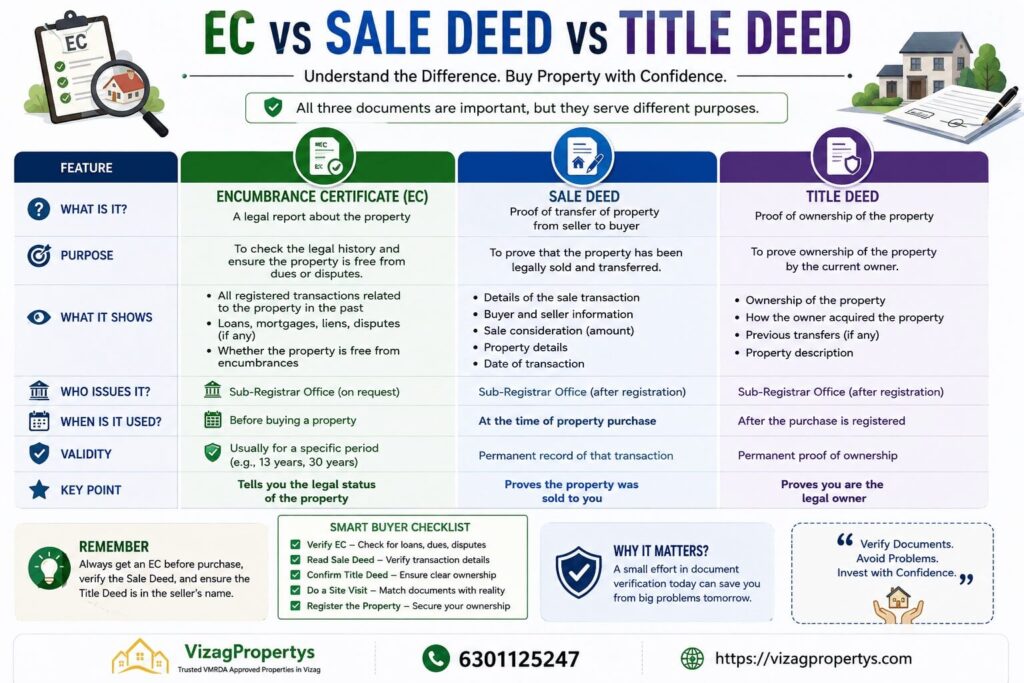
Encumbrance Certificate (EC) vs Title Deed
Many first-time buyers believe these two documents are the same.
They are not.
An Encumbrance Certificate records registered transactions during a selected period, while a Title Deed is the document through which ownership rights are established and transferred.
Both are important, but they serve different purposes.
Comparison Table
| Feature | Encumbrance Certificate (EC) | Title Deed |
|---|---|---|
| Purpose | Shows registered transactions during the selected period | Establishes ownership rights |
| Issued By | Registration Department | Executed and registered between parties |
| Shows Ownership History | Partially, through registered transactions | Identifies the ownership being conveyed |
| Used By Banks | Commonly reviewed | Commonly reviewed |
| Required Before Purchase | Yes | Yes |
| Alone Is Sufficient? | No | No |
Why Both Documents Matter
Suppose you are buying a plot in Anandapuram or Bheemili.
A satisfactory EC is encouraging, but you should also examine the Title Deed to understand how ownership has been conveyed and ensure it aligns with the overall document set.
Encumbrance Certificate (EC) vs Sale Deed
These two documents are also commonly confused.
What is a Sale Deed?
A Sale Deed is the legal document executed when ownership of a property is transferred from the seller to the buyer.
It generally contains details such as:
- Buyer’s name
- Seller’s name
- Property description
- Sale consideration
- Rights transferred
- Registration details
How Is It Different from an EC?
The Sale Deed records a specific transaction, while the Encumbrance Certificate summarizes registered transactions relating to the property during the chosen search period.
Comparison Table
| Feature | Encumbrance Certificate | Sale Deed |
|---|---|---|
| Shows Transaction History | Yes, within the selected period | No |
| Transfers Ownership | No | Yes |
| Required for Registration | Used for verification | Executed during the sale |
| Helps Banks Verify Property | Yes | Yes |
| Should Buyers Check It? | Absolutely | Absolutely |
Practical Example
Suppose you are purchasing a VMRDA Approved Plot in Vizag.
The seller provides:
- Sale Deed
- EC
- Layout Approval
- LP Number
Instead of checking only one document, compare all of them.
Confirm that:
- Property description matches.
- Survey Number is consistent.
- Plot dimensions match.
- Registration details are consistent across the documents.
Consistency between documents is an important part of the verification process.
Encumbrance Certificate (EC) vs Mother Deed
The Mother Deed is another important document that many buyers hear about but do not fully understand.
What is a Mother Deed?
A Mother Deed is a document that helps establish the history of ownership by tracing previous transfers of the property over time.
It is commonly used during legal verification to understand how ownership has passed from one owner to another.
Why Is It Important?
When purchasing land, especially in developing areas around Visakhapatnam, reviewing the ownership history can provide valuable context.
The Mother Deed helps legal professionals understand that history alongside other supporting documents.
Comparison Table
| Feature | Encumbrance Certificate | Mother Deed |
|---|---|---|
| Purpose | Shows registered transactions | Traces ownership history |
| Used During Legal Verification | Yes | Yes |
| Issued by Registration Department | Yes | No (it is part of the ownership document chain) |
| Helps Establish Ownership | Supports verification | Yes |
| Should Buyers Review It? | Yes | Yes |
Which Document Is Most Important?
Many buyers ask:
“If I have only one document, which should it be?”
The correct answer is:
No single document is enough.
A safe property purchase involves reviewing several documents together.
Property Verification Checklist
Before purchasing a plot, review:
- Encumbrance Certificate (EC)
- LP Number
- Survey Number
- VMRDA Layout Approval
- Title Deed
- Sale Deed
- Mother Deed
- Property Tax Records
- Identity of the Seller
- Site Measurements
- Physical Boundaries
- Road Access
- Any other documents relevant to your transaction
Looking at the complete set of documents provides much greater confidence than relying on any one document alone.
Common Questions Buyers Ask
“If the EC is clean, is the property automatically safe?”
A satisfactory EC is an encouraging sign, but buyers should still complete the full document verification process.
“If I have the Sale Deed, do I still need the EC?”
Yes.
Both documents provide different information and complement each other during due diligence.
“Do banks verify both?”
Banks typically examine multiple legal documents as part of their assessment, which may include the EC, Sale Deed, Title Deed, and other records depending on the loan and property.
Expert Advice
When investing in Plots in Vizag, VMRDA Approved Plots, or plots near Bhogapuram International Airport, don’t focus only on location, price, or future appreciation.
A strong investment combines:
- A promising location,
- Proper legal documentation,
- Thorough verification,
- And informed decision-making.
Taking the time to review the right documents today can help you avoid unnecessary complications in the future.
Need Guidance Before Buying a Plot?
Buying a plot is a long-term investment, and understanding the purpose of documents like the Encumbrance Certificate, Sale Deed, Title Deed, and Mother Deed can make the process much smoother.
If you’re exploring VMRDA Approved Plots in Vizag and would like help understanding the documentation involved in a property purchase, the team at VizagPropertys is ready to guide you with clear information and practical assistance.
Common Mistakes Buyers Make While Checking an Encumbrance Certificate
One of the biggest mistakes buyers make is assuming that obtaining an Encumbrance Certificate is the final step in property verification.
In reality, the EC is an important document, but understanding how to read it correctly is equally important.
Many legal issues arise not because buyers skipped obtaining an EC, but because they misunderstood what the document actually tells them.
Whether you are purchasing VMRDA Approved Plots in Vizag, an investment plot near Bhogapuram International Airport, or a residential plot in Anandapuram, Bheemili, Kothavalasa, or Atchutapuram, understanding these common mistakes can help you make better decisions.
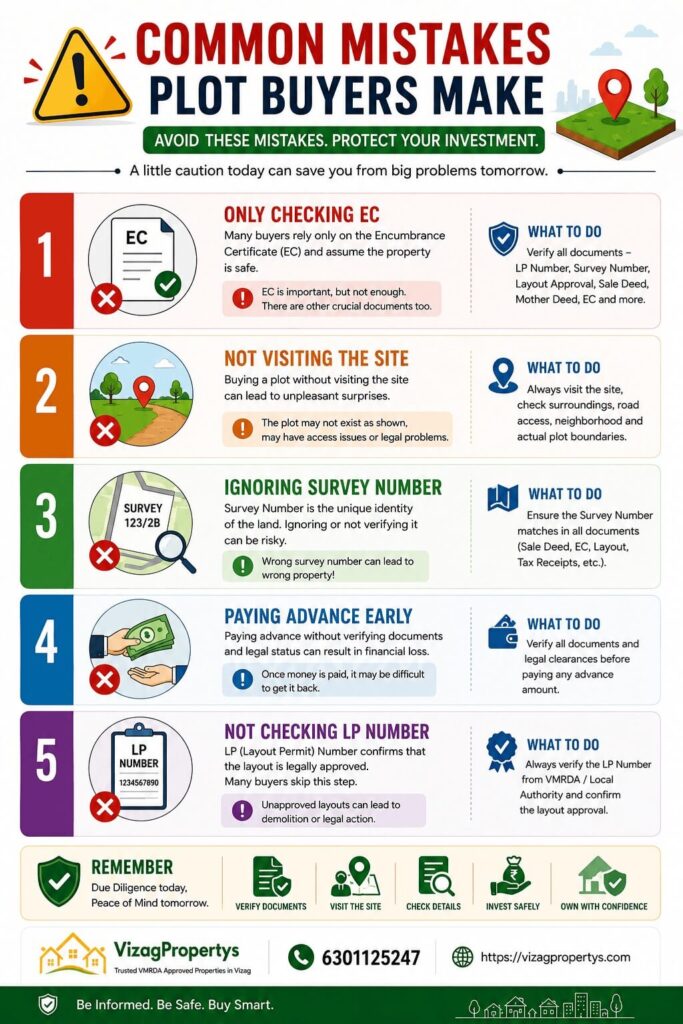
Mistake 1: Checking Only the EC
This is probably the most common mistake.
Some buyers believe:
“The EC is clean, so everything is fine.”
A clean EC is encouraging, but it is only one part of the verification process.
You should also review:
- LP Number
- Survey Number
- VMRDA Layout Approval
- Sale Deed
- Mother Deed
- Title documents
- Property Tax Receipts
- Physical site boundaries
- Seller identity
Mistake 2: Ignoring Property Details
Many buyers focus only on names or document numbers.
Instead, compare the EC with other documents and verify that details such as:
- Survey Number
- Village
- Mandal
- District
- Property extent
- Property description
are consistent.
Even small differences should be clarified before proceeding.
Mistake 3: Not Reviewing the Entire Search Period
Some buyers review only the latest entries.
Instead, carefully examine the entire EC issued for the selected search period.
Review:
- Dates
- Registered transactions
- Document numbers
- Nature of each transaction
Taking a few extra minutes can help you understand the property’s recorded history more clearly.
Mistake 4: Paying an Advance Before Verification
Sometimes buyers become excited because:
- The location is attractive.
- The price seems reasonable.
- The seller says other buyers are interested.
Without checking the documents, they pay a booking amount or advance.
A better approach is to complete document verification first and then make financial commitments.
Mistake 5: Skipping the Physical Site Visit
An EC cannot confirm:
- Boundary stones
- Road width
- Actual plot location
- Physical possession
- Neighbouring developments
Always visit the site personally before registration.
For buyers considering Plots in Vizag, combining document verification with a physical inspection provides a much clearer picture of the investment.
Real-Life Example
Imagine two investors interested in plots near Bhogapuram.
Investor A
- Likes the location.
- Checks only the EC.
- Pays an advance immediately.
Investor B
Before making any payment, Investor B verifies:
- EC
- LP Number
- Survey Number
- Layout Approval
- Sale Deed
- Mother Deed
- Property dimensions
- Physical boundaries
- Site access
Although it takes a little more time, Investor B has completed a much more thorough verification process before investing.
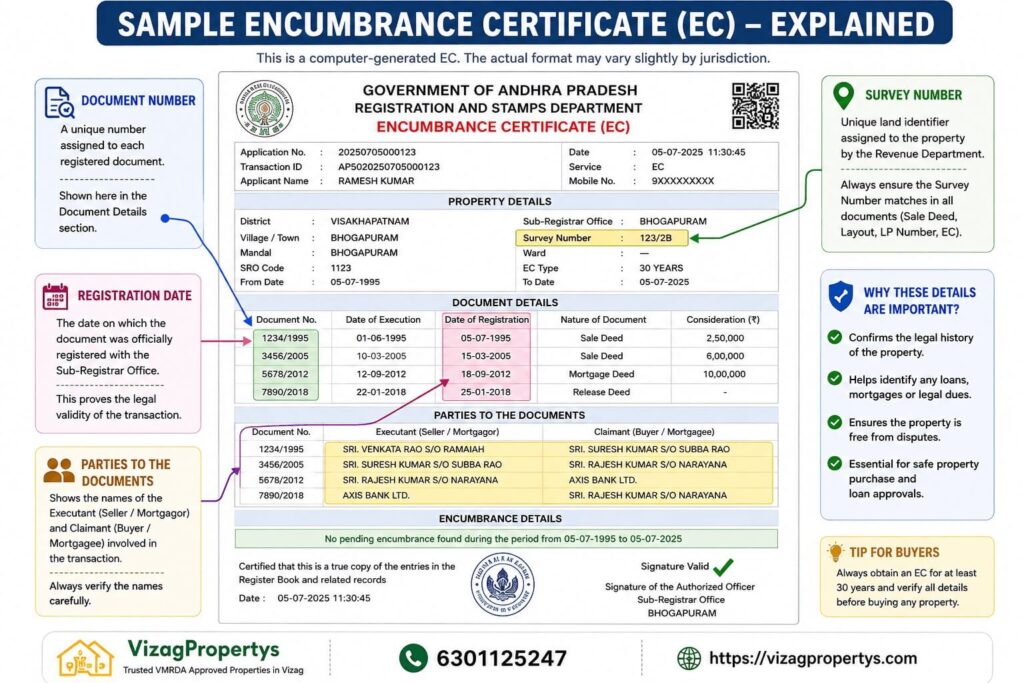
Sample Encumbrance Certificate Explained
When you first look at an EC, it may appear confusing because it contains legal terminology and registration details.
Instead of worrying about every line, focus on understanding the key sections.
A typical EC may include:
Property Details
This identifies the property being searched.
Look for:
- Survey Number
- Village
- Mandal
- District
- Property description
These details should match the seller’s documents.
Registration Details
Each recorded transaction generally includes:
- Registration Date
- Document Number
- Registration Office
These details help identify the registered document.
Parties to the Transaction
The EC usually records the names of the parties involved in each registered transaction.
Review these carefully and compare them with the ownership documents available.
Nature of the Transaction
The EC generally indicates the type of registered transaction, such as:
- Sale
- Gift
- Settlement
- Release
- Registered Mortgage
Understanding the nature of each entry helps you build a clearer picture of the property’s registration history.
The annotated sample below highlights the key sections you should review when examining an Encumbrance Certificate (EC).
How to Read an EC Like an Experienced Buyer
Instead of asking:
“Is there an EC?”
Ask:
- Does the property description match?
- Are the Survey Numbers correct?
- Are the registration details consistent?
- Does the ownership history align with the other documents?
- Are there entries that need clarification?
This approach encourages a more careful review of the available records.
Can an Encumbrance Certificate Be Wrong?
This is another common question.
An Encumbrance Certificate is prepared based on the registered records available for the selected search period.
If you notice any inconsistency or if something does not match your other property documents, do not make assumptions.
Instead:
- Compare the EC with the Sale Deed.
- Compare it with the Title documents.
- Review the Survey Number.
- Seek clarification from the seller.
- Consult a qualified legal professional if required.
Resolving questions before registration is usually easier than addressing them afterwards.
What Should You Do If the EC Shows a Registered Mortgage?
Finding a registered mortgage entry does not automatically mean that you should reject the property.
Instead:
- Understand the nature of the entry.
- Discuss it with the seller.
- Ask for supporting documentation if appropriate.
- Verify whether the relevant documentation has been completed.
- Seek legal guidance if needed before proceeding.
The key is to understand the transaction rather than making assumptions.
Can You Get a Bank Loan Without an EC?
Banks evaluate multiple aspects before approving a property loan.
As part of that process, they commonly request several legal documents, which may include an Encumbrance Certificate.
Requirements vary depending on the lender and the specific transaction.
Before applying for a loan, check the document requirements of your chosen bank or financial institution.
Why Banks Review an EC
Banks use legal documents to better understand the property being offered as security.
The EC helps them review the property’s registered transaction history for the selected period.
However, it is usually assessed alongside documents such as:
- Sale Deed
- Title documents
- Layout Approval
- Identity documents
- Other records required under the bank’s lending process
Expert Advice Before Buying a Plot
Whether you are investing in:
- VMRDA Approved Plots in Vizag
- Residential plots near Bhogapuram Airport
- Investment plots in Anandapuram
- Open plots in Bheemili
- Layouts in Kothavalasa
- Developing areas around Visakhapatnam
follow a systematic verification process.
Never rely on:
- Advertisements alone.
- Verbal assurances.
- Attractive prices.
- Limited documentation.
Instead, verify the property carefully before making your investment.
Buyer Verification Checklist Before Paying an Advance
| Verification Question | Why It Matters | Status | Verified On | Remarks |
|---|---|---|---|---|
| Have I reviewed the Encumbrance Certificate (EC)? | Helps review the registered transaction history of the property. | ☐ | __________ | __________________ |
| Does the Survey Number match all property documents? | Confirms consistency across the EC, Sale Deed, and Layout Plan. | ☐ | __________ | __________________ |
| Is the LP Number available and verified? | Confirms the approved layout details. | ☐ | __________ | __________________ |
| Is the layout approved by VMRDA? | Helps verify that the layout has the required approval. | ☐ | __________ | __________________ |
| Have I checked the Sale Deed? | Helps verify the registered ownership transfer. | ☐ | __________ | __________________ |
| Have I reviewed the Mother Deed? | Helps understand the ownership history of the property. | ☐ | __________ | __________________ |
| Have I verified the Title Documents? | Supports confirmation of the seller's ownership rights. | ☐ | __________ | __________________ |
| Have I checked the latest Property Tax Receipts? | Helps verify available tax records. | ☐ | __________ | __________________ |
| Have I visited the site personally? | Confirms the actual location and surroundings. | ☐ | __________ | __________________ |
| Do the physical measurements match the approved layout? | Helps ensure the plot dimensions are consistent. | ☐ | __________ | __________________ |
| Have I checked the physical boundaries? | Helps confirm the plot's actual limits on the ground. | ☐ | __________ | __________________ |
| Does the plot have proper road access? | Ensures the property has suitable access. | ☐ | __________ | __________________ |
| Have I verified the seller's identity? | Confirms the seller matches the ownership records. | ☐ | __________ | __________________ |
| Have I clarified any questions about the property's history? | Reduces uncertainty before making a financial commitment. | ☐ | __________ | __________________ |
| Have I consulted a legal professional if required? | Provides additional confidence for complex transactions. | ☐ | __________ | __________________ |
If you answered “Yes” to all the questions above, you’ve completed a strong preliminary verification process. However, before completing your purchase, consider having the documents reviewed by a qualified legal professional and ensure all registration formalities are completed according to the applicable laws and procedures.
Need Help Understanding Property Documents?
Legal documents can seem overwhelming, especially if you are buying land for the first time.
Understanding the purpose of the Encumbrance Certificate, LP Number, Survey Number, and other important records is a valuable step toward making a confident investment.
If you’re exploring VMRDA Approved Plots in Vizag and would like guidance on understanding the documentation involved in a plot purchase, VizagPropertys is committed to helping buyers make informed decisions through transparent information and verified layouts.
Is an Encumbrance Certificate (EC) Enough Before Buying Land?
After reading the previous sections, you may wonder:
“If I have a clean Encumbrance Certificate, can I safely buy the plot?”
The simple answer is:
No.
An Encumbrance Certificate is one of the most important documents in the property verification process, but it should not be the only document you rely on before purchasing land.
Think of an EC as one piece of a larger puzzle. To make a confident buying decision, you should review multiple documents together and ensure they are consistent with each other.
This approach is especially important when purchasing VMRDA Approved Plots in Vizag, where buyers often invest significant savings for long-term appreciation or to build their dream home.
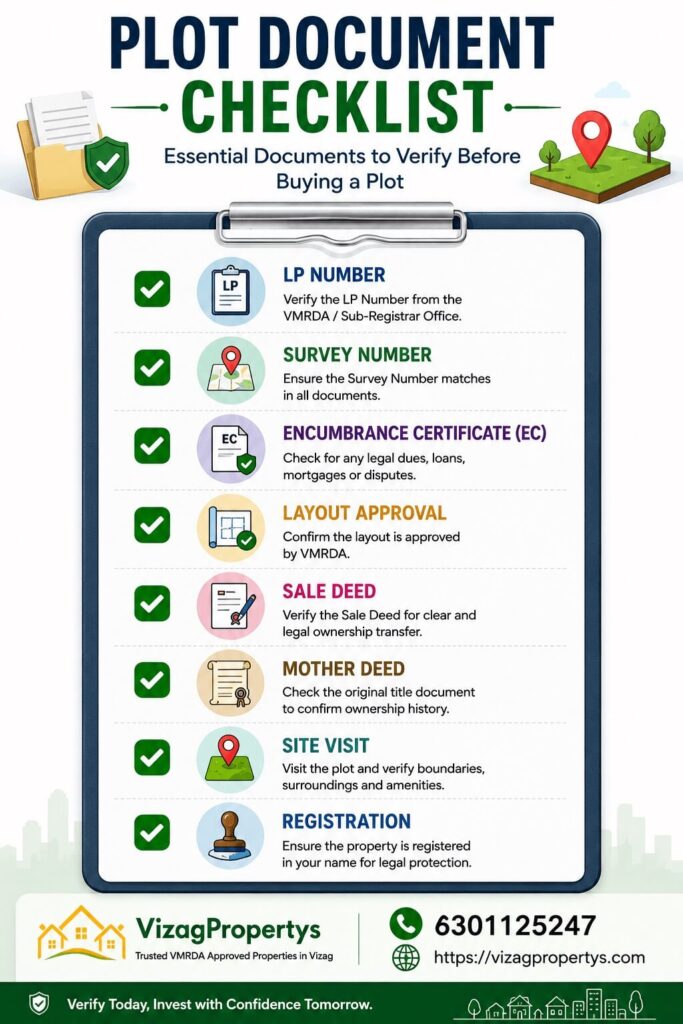
Complete Property Document Verification Checklist
Before purchasing any residential or investment plot, review the following documents carefully.
1. Encumbrance Certificate (EC)
Purpose:
- Review registered property transactions during the selected period.
- Understand the registered transaction history.
2. LP Number
Verify that the layout approval details correspond to the approved layout.
If you haven’t already, read our guide on LP Number Explained to understand why it is an important part of plot verification.
3. Survey Number
Ensure the Survey Number matches across:
- EC
- Sale Deed
- Layout Plan
- Registration documents
Any mismatch should be clarified before proceeding.
4. Layout Approval
If you are purchasing a VMRDA Approved Plot in Vizag, verify that the layout approval details match the property you intend to buy.
5. Sale Deed
Review the Sale Deed carefully and compare its details with the other property documents.
6. Title Documents
The ownership documents should support the seller’s right to transfer the property.
If you have questions about ownership records, consider obtaining appropriate legal advice.
7. Mother Deed
Reviewing the Mother Deed helps establish the ownership history of the property.
8. Property Tax Receipts
Ask the seller for the latest available property tax receipts, where applicable.
9. Identity of the Seller
Confirm that the seller’s identity matches the ownership documents and registration records.
10. Physical Site Verification
A site visit is essential.
Confirm:
- Plot location
- Boundary markings
- Road access
- Neighbouring development
- Approximate dimensions
11. Site Measurements
Ensure the physical measurements correspond with the approved layout and supporting documents.
12. Road Access
Check whether the plot has proper access and whether the approach road matches the approved layout.
After completing document verification, buyers should also understand the registration costs involved before proceeding with the purchase. For a detailed breakdown, see our guide to Plot Registration Charges in Andhra Pradesh (2026–2027).
Golden Rule for Plot Buyers
Never depend on a single document.
A good investment decision is based on reviewing the complete set of relevant documents together.
Frequently Asked Questions (FAQs)
1. What is an Encumbrance Certificate?
An Encumbrance Certificate is a document issued by the Registration Department that records registered transactions relating to a property during a specified search period.
2. Is an EC mandatory before buying a plot?
While an EC is widely regarded as an important document for property verification, buyers should also review other relevant documents before purchasing.
3. Can I buy land without checking the EC?
Skipping the EC means missing an important part of the property’s registered transaction history. It is generally advisable to include it in your verification process.
4. Does an EC prove ownership?
No. An EC records registered transactions during the selected period. Ownership should be established through the complete set of title and supporting documents.
5. Does a clean EC guarantee a legally problem-free property?
No. A clean EC is encouraging, but it should be reviewed together with other documents and, where appropriate, legal advice.
6. How many years of EC should I check?
The appropriate search period depends on the property’s history, lender requirements, and professional advice. Many buyers prefer reviewing a longer transaction history.
7. Can I apply for a bank loan without an EC?
Banks usually review multiple legal documents as part of their assessment. Requirements vary between lenders.
8. Does the EC show all legal disputes?
No. An EC should not be treated as a complete record of every possible legal issue.
9. What is the difference between an EC and a Sale Deed?
A Sale Deed transfers ownership, while an EC records registered transactions relating to the property during the selected period.
10. What is the difference between an EC and a Title Deed?
The Title Deed establishes ownership rights, whereas the EC records registered transactions.
11. What is the difference between an EC and a Mother Deed?
The Mother Deed helps establish ownership history, while the EC reflects registered transactions for the chosen period.
12. Can I obtain an EC online in Andhra Pradesh?
The Andhra Pradesh Registration Department provides online services for many property-related searches, including Encumbrance Certificates.
13. Why do banks ask for an EC?
Banks often review the EC to understand the registered transaction history of the property as part of their lending process.
14. Should I compare the EC with the Sale Deed?
Yes. Comparing multiple documents helps ensure consistency and supports a thorough verification process.
15. Can an EC contain mistakes?
If you notice inconsistencies, compare the EC with other property documents and seek clarification before proceeding.
16. What should I do if I don't understand the EC?
Seek guidance from a qualified legal professional or a trusted property expert before making a purchase decision.
17. Is the EC important for VMRDA Approved Plots?
Yes. Even when purchasing VMRDA Approved Plots in Vizag, reviewing the EC remains an important part of legal due diligence.
18. Is a site visit still necessary after checking the EC?
Absolutely. A physical inspection helps confirm boundaries, access, and the property’s actual condition.
19. Should first-time buyers verify all documents?
Yes. First-time buyers benefit greatly from reviewing all important documents before investing.
20. What is the safest way to buy a plot?
The safest approach is to combine document verification, physical site inspection, and, where required, professional legal guidance before completing the purchase.
Final Thoughts
Buying a plot is more than a financial transaction—it’s a long-term investment in your future.
Whether you’re planning to build your dream home, secure land for your family, or invest in the rapidly developing areas around Visakhapatnam, Bhogapuram, Anandapuram, Bheemili, Kothavalasa, or Atchutapuram, taking the time to verify the property’s documents is one of the smartest decisions you can make.
An Encumbrance Certificate is an important part of that journey, but it works best when reviewed alongside the LP Number, Survey Number, layout approval, ownership documents, and a physical site inspection.
A careful verification process today can help you invest with greater confidence tomorrow.
Planning to Buy a VMRDA Approved Plot in Vizag?
At VizagPropertys, we focus exclusively on VMRDA Approved Plots in Vizag and nearby growth corridors.
We believe buyers should have complete information before making one of life’s biggest investments.
If you’re looking for:
- Legally verified VMRDA-approved layouts
- Guidance on understanding plot documents
- Help comparing locations around Visakhapatnam
- Information about plots near Bhogapuram International Airport
our team is here to help you make an informed decision.
Related Helpful Guides
Explore these related guides from VizagPropertys to make well-informed decisions when buying VMRDA-approved plots in and around Vizag.
Buying & Investment Guides
- LP Number Explained – Complete Guide
- VMRDA Approved Plots in Vizag
- VUDA Approved Plots in Vizag
- Bhogapuram International Airport – Complete Guide
- Why Invest in Vizag Real Estate?
- Mortgage Plots in VUDA/VMRDA Approved Layouts
- BBG Beverly Hills Investment Guide
Explore our VMRDA-approved plot projects: