
Plot Registration Charges in Andhra Pradesh (2026–2027): Complete Guide
Complete Guide to Stamp Duty, Registration Fees, Transfer Duty, Cost Calculator & Registration Process
Planning to buy a plot in Andhra Pradesh? Understanding the total registration cost is just as important as negotiating the purchase price. Apart from the cost of the plot, buyers must also budget for government charges such as stamp duty, registration fee, transfer duty, and other applicable expenses. Knowing these costs in advance helps you avoid unexpected financial surprises on registration day.
Whether you’re a first-time homebuyer, property investor, NRI, government employee, or planning to purchase VMRDA-approved plots in Vizag, this comprehensive guide explains everything you need to know about plot registration charges in Andhra Pradesh in simple, easy-to-understand language.
You’ll learn how registration charges are calculated, understand the difference between market value and sale consideration, see worked cost examples for different plot prices, discover the complete registration process, and find practical tips to make your property registration smooth and hassle-free.
Important: Property registration charges and government fees may be revised through notifications issued by the Andhra Pradesh Government. The examples and explanations in this guide are intended for educational purposes. Before completing your registration, always verify the latest applicable charges using the official Andhra Pradesh Registration & Stamps Department or the IGRS Andhra Pradesh portal.
Property Expert Tip: Before finalizing any plot purchase, estimate not only the registration charges but also your complete acquisition budget, including legal verification, documentation, and post-registration expenses. A well-planned budget helps avoid last-minute surprises and ensures a smoother buying experience.

Quick Registration Charges Summary
For a standard sale deed involving a residential plot in Andhra Pradesh, the government charges commonly include:
| Government Charge | Commonly Applicable Rate* | Purpose |
|---|---|---|
| Stamp Duty | 5% | Tax payable to the Government on the property transaction |
| Registration Fee | 1% | Fee charged for legally registering the Sale Deed |
| Transfer Duty | 1.50% | Duty collected by the local authority for transfer of property |
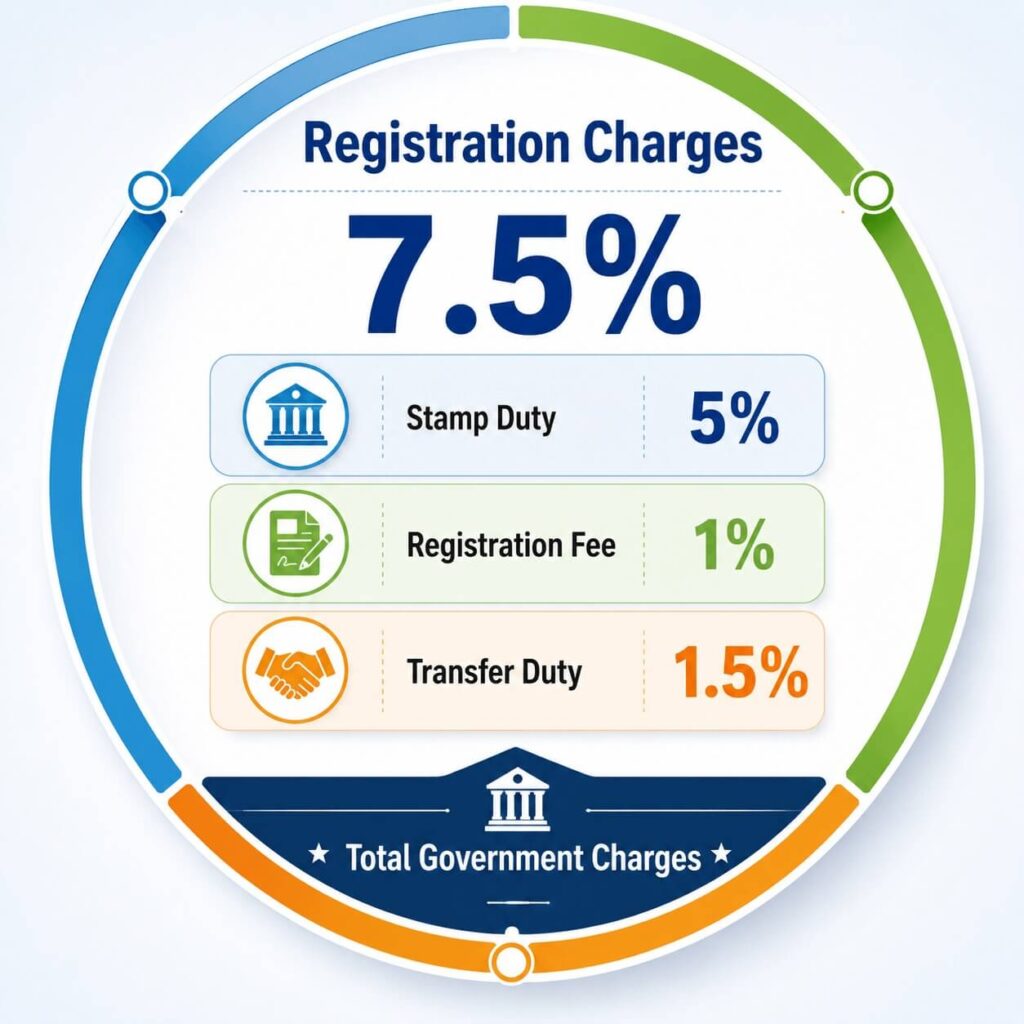
| Total Government Charges | Approximately 7.5% | Combined statutory charges (subject to applicable rules) |
*Important Note: These rates are generally applicable to many standard sale deed registrations but can vary depending on the document type, property category, applicable government notifications, concessions, exemptions, or future revisions. Registration charges are typically calculated on the higher of the sale consideration or the government market (guideline) value, subject to applicable laws and regulations. Always verify the latest rates and payable amounts through the official Andhra Pradesh Registration & Stamps Department before registration.
What You’ll Learn in This Guide
By the end of this guide, you’ll have a clear understanding of:
- What property registration is and why it is legally important when buying a plot.
- The latest plot registration charges in Andhra Pradesh, including Stamp Duty, Registration Fee, and Transfer Duty.
- How registration charges are calculated and which value is used for calculation.
- The difference between Market Value, Guideline Value, and Sale Consideration.
- How to estimate your total registration cost before buying a plot.
- Practical worked examples for plots costing ₹15 Lakhs to ₹1 Crore.
- The documents required from both the buyer and seller.
- The complete property registration process, from preparing the Sale Deed to completing registration and biometric verification.
- How the IGRS Andhra Pradesh portal and Sub-Registrar Office (SRO) are involved in the registration process, including online services, slot booking, and eKYC.
- A practical registration-day checklist and the common mistakes buyers should avoid.
- What to do after registration, including updating property records and completing applicable mutation procedures.
- Frequently Asked Questions about plot registration charges and the registration process in Andhra Pradesh.
Why Understanding Registration Charges Matters
Many buyers focus only on the advertised price of a plot and overlook the additional government charges that become payable during registration. This can lead to last-minute budget shortfalls and unnecessary stress.
For example, a buyer planning to purchase a ₹30 lakh plot may need to budget not only for the purchase price but also for applicable registration charges and certain incidental expenses. Understanding these costs in advance allows you to:
- Plan your overall property budget more accurately.
- Avoid unexpected expenses at the time of registration.
- Compare different property options with confidence.
- Complete the registration process without delays caused by insufficient funds.
- Make informed decisions before signing the Sale Deed.
Throughout this guide, we’ll explain each component of the registration cost in detail and provide worked examples to help you estimate your likely expenses.
Looking for VMRDA-Approved Plots in Vizag?
If you’re planning to buy a VMRDA-approved open plot in and around Visakhapatnam, it’s equally important to verify the property’s legal documents, approval status, and estimated registration costs before making a purchase.
At VizagPropertys, we focus on helping buyers explore VMRDA-approved layouts and understand the buying process with clear, educational guidance. Along with this registration guide, you’ll also find detailed resources on LP Numbers, Encumbrance Certificates, document verification, and other topics that can help you make informed property decisions.
If you have questions about the registration process or want assistance in choosing a VMRDA-approved plot, feel free to call us at 6301125247, send us a WhatsApp message, or book a free site visit. We’re happy to guide you through the process and help you make a confident purchase.
Understanding Plot Registration Charges in Andhra Pradesh Before You Buy
Buying a plot is one of the biggest financial decisions most people make. Whether you’re planning to build your dream home, invest for future appreciation, or purchase land for your family, understanding the total cost of ownership is just as important as choosing the right location.
Many buyers focus only on the advertised plot price and assume that the amount quoted by the seller is the final amount they need to pay. However, when it comes to property registration in Andhra Pradesh, the purchase price is only one part of the overall cost. Government charges such as stamp duty, registration fee, transfer duty, and other applicable expenses can significantly increase the total amount you need to budget for before the property can be legally registered in your name.
Unfortunately, these additional costs often come as a surprise to first-time buyers. Some buyers discover the actual registration expenses only a few days before visiting the Sub-Registrar Office, leaving them scrambling to arrange additional funds. Others rely on outdated information from friends, social media, or old articles that may no longer reflect the latest rules or government notifications.
This guide has been created to help you avoid those situations.
Instead of simply listing registration percentages, we’ve put together a practical resource that explains how property registration works in Andhra Pradesh, how registration charges are calculated, which government fees you may need to pay, what documents are required, and how to prepare for a smooth registration process.
Whether you’re buying a VMRDA-approved plot in Visakhapatnam, investing in land near Bhogapuram, purchasing a residential plot in Anandapuram, Bheemili, Kothavalasa, Vizianagaram, Anakapalli, or any other part of Andhra Pradesh, the registration process follows the same legal principles. Understanding those principles before making a purchase can help you make informed decisions and avoid costly mistakes.
Why This Guide Is Different
There are many articles online that briefly mention stamp duty or registration fees, but very few explain the complete picture from a buyer’s perspective.
This guide goes beyond simply listing government charges. It is designed to answer the practical questions that buyers commonly ask before purchasing a plot.
For example:
- How are registration charges calculated?
- Is the registration cost based on the sale price or the government market value?
- What documents should you verify before registration?
- What happens at the Sub-Registrar Office?
- How long does the registration process take?
- What should you do after the property is registered?
- What additional expenses should you budget for apart from government charges?
By bringing all of this information together in one place, our goal is to help you understand the entire registration journey—from planning your budget to completing the legal transfer of ownership.
Who Should Read This Guide?
This guide is especially useful for anyone planning to purchase or register a residential plot in Andhra Pradesh, including:
- First-time plot buyers who want to understand the registration process from start to finish.
- Families planning to build a home on a legally approved plot.
- Property investors looking for land with long-term investment potential.
- NRIs exploring plot investment opportunities in Andhra Pradesh.
- Salaried professionals, government employees and IT professionals purchasing a plot for future use or investment.
- Retirees planning to invest in residential land.
- Buyers looking for VMRDA-approved plots in and around Visakhapatnam (Vizag).
- Anyone planning to register a residential plot in Andhra Pradesh and wanting to understand the applicable government charges, documents, and procedures.
Whether you’re purchasing a plot in Visakhapatnam (Vizag), Bhogapuram, Anandapuram, Bheemili, Kothavalasa, Atchutapuram, Vizianagaram, Anakapalli, or elsewhere in Andhra Pradesh, understanding the latest registration requirements and costs can help you make a more informed financial decision.
Even if you have purchased property before, registration procedures, documentation requirements, and applicable government charges can change over time. Reviewing the latest information before completing your transaction can help you avoid unexpected costs and delays.
A Quick Note Before We Begin
While we’ve taken care to explain the registration process in simple and practical terms, property registration laws, applicable charges, and administrative procedures can change over time through government notifications or amendments.
For that reason, this guide should be used as an educational resource to help you understand the process and plan your purchase. Before completing any property registration, always confirm the latest applicable charges, document requirements, and procedures through the official Andhra Pradesh Registration & Stamps Department or by consulting a qualified legal professional if your transaction involves special circumstances.
If you’re purchasing a VMRDA-approved plot in or around Visakhapatnam, understanding the registration process is only one part of buying safely. It’s equally important to verify the property’s approval status, title documents, and encumbrance history before registration. Throughout this guide, you’ll also find links to our related resources that explain these topics in greater detail, helping you make informed decisions at every stage of your property purchase.
Current Plot Registration Charges in Andhra Pradesh (2026–2027)
Quick Overview of Government Registration Charges
Before purchasing a plot, it’s important to understand the government charges that are payable during property registration. These charges are separate from the purchase price of the plot and are generally collected at the time of registering the Sale Deed.
For a standard sale deed involving a residential plot in Andhra Pradesh, the commonly applicable government charges include Stamp Duty, Registration Fee, and Transfer Duty. Together, these charges form a significant part of your overall purchase budget.
Important: Government charges are subject to the applicable laws, government notifications, and the nature of the transaction. The information below is intended as a general guide. Always verify the latest applicable rates and payable amounts through the official Andhra Pradesh Registration & Stamps Department before completing your property registration.
Registration Charges Summary
| Government Charge | Commonly Applicable Rate* | Purpose |
|---|---|---|
| Stamp Duty | 5% | Government tax on the property transaction |
| Registration Fee | 1% | Fee for registering the Sale Deed |
| Transfer Duty | 1.50% | Local body transfer duty |
| Approximate Total | 7.50% | Combined statutory charges for many standard residential sale deed registrations |
Please Note:
- These percentages generally apply to many standard residential plot sale deed registrations in Andhra Pradesh.
- The actual payable amount depends on the document type, property category, applicable exemptions, concessions, local rules, and any future government revisions.
- Charges are typically calculated on the higher of the sale consideration or the government market (guideline) value.
- Additional user charges or document-specific fees may also apply depending on the transaction.
Understanding Each Government Charge
Many buyers assume that “registration charges” are a single fee. In reality, the total amount usually consists of multiple government charges, each serving a different purpose.
Let’s understand them one by one.
1. Stamp Duty
Stamp Duty is a tax collected by the Government on certain property transactions. It is one of the largest components of the registration cost and forms part of the legal process of transferring ownership through a registered Sale Deed.
The amount payable is generally calculated on the value that is applicable under the relevant rules, which is commonly the higher of the sale consideration or the government market value.
In the next section of this guide, we’ll explain Stamp Duty in detail, including why it is charged, how it is calculated, and practical examples.
2. Registration Fee
The Registration Fee is charged for officially recording the Sale Deed in the records maintained by the Registration & Stamps Department.
Once the document is registered, the transaction becomes part of the official public record, providing legal evidence of the transfer of ownership.
We’ll discuss the Registration Fee in detail later, including its purpose, calculation, and common questions.
3. Transfer Duty
Transfer Duty is generally collected as part of the property transfer process and is intended to support local bodies such as municipalities or panchayats, depending on the location of the property.
Although buyers often include it under “registration charges,” it is a separate component from Stamp Duty and the Registration Fee.
We’ll explain where Transfer Duty applies and how it contributes to the overall registration cost in a later section.
4. Other Applicable Charges
Depending on your specific transaction, you may also incur additional costs such as:
- Document preparation or drafting charges
- Advocate or legal consultation fees
- Encumbrance Certificate copy charges (if obtaining certified copies)
- Bank loan processing fees (if financed)
- Valuation or verification-related expenses (where applicable)
- Miscellaneous administrative costs
These are not always government registration charges, but they are often part of the overall cost of completing a property purchase.
How Are Registration Charges Calculated?
One of the most common questions buyers ask is:
“Are registration charges calculated on the amount I pay the seller?”
The answer is not always.
In Andhra Pradesh, registration charges are generally calculated on the higher of:
- The agreed sale consideration mentioned in the Sale Deed, or
- The government-assessed market (guideline) value applicable to the property,
subject to the relevant laws and registration rules.
Example
Suppose:
- Agreed sale price: ₹24,00,000
- Government market value: ₹26,00,000
In many standard cases, the registration charges would be calculated using ₹26,00,000, because it is the higher value.
Similarly:
- Agreed sale price: ₹32,00,000
- Government market value: ₹30,00,000
The calculation would generally be based on ₹32,00,000, as it is the higher amount.
Understanding this principle helps buyers estimate their registration budget more accurately and avoid unexpected expenses.
Plot Registration Charges in Vizag (Visakhapatnam)
If you are planning to buy residential plots in Vizag (Visakhapatnam), understanding the registration cost is an important part of calculating your total property budget.
The basic registration framework applicable to a plot transaction in Visakhapatnam comes under the Andhra Pradesh Registration & Stamps Department. Therefore, the main components of the registration cost are governed by the applicable Andhra Pradesh rules rather than by a completely separate “Vizag registration rate.”
For a typical sale of an immovable property, the major government levies generally include:
- Stamp Duty
- Registration Fee
- Transfer Duty
- Applicable user or service charges, where relevant
For many standard sale transactions in Andhra Pradesh, commonly reported rates are 5% stamp duty, 1% registration fee and 1.5% transfer duty, making the combined statutory components approximately 7.5% before considering any applicable additional charges or transaction-specific provisions. However, buyers should not assume that simply multiplying the negotiated plot price by 7.5% will always give the exact amount payable.
The actual amount depends on the applicable valuation and the nature and location of the transaction.
Why Registration Charges in Vizag Can Vary
One of the most important things for a plot buyer in Visakhapatnam to understand is that the price negotiated between the buyer and seller is not necessarily the only figure that matters for calculating registration charges.
The Registration Department uses the applicable government valuation/basic value or other legally relevant valuation basis for the property. Where the applicable government value is higher than the declared consideration, the higher value can affect the calculation of statutory duties and fees.
This becomes particularly important in Vizag because property values can differ significantly between locations.
For example, the applicable government valuation for a plot in an established urban locality may be very different from that of a developing peripheral area. Even within the wider Visakhapatnam region, government values can vary according to locality, road access, land use, classification and other factors.
The Andhra Pradesh Government undertook a revision of land market values in 2026, with revised values coming into effect from February 1, 2026. Therefore, buyers should always check the current applicable value for the specific property before registration rather than relying on an old calculation or a previous transaction in the same area.
Does Vizag Have a Different Registration Charge Rate?
Generally, you should not think of Vizag as having a completely separate percentage structure from the rest of Andhra Pradesh simply because the property is located in Visakhapatnam.
The important difference for a Vizag buyer is often the applicable government valuation of the specific property.
In other words:
The percentage components may be governed at the Andhra Pradesh level, but the value on which those charges are calculated can vary according to the property and its location.
This is why two plots with the same negotiated price can potentially require different calculations if the applicable government valuation or other transaction details differ.
Registration Cost for a VMRDA-Approved Plot in Vizag
If you are buying a VMRDA-approved open plot, the fact that the layout is approved does not mean that registration charges are automatically waived or reduced.
A VMRDA-approved plot is still subject to the applicable registration and stamp-duty requirements for the transaction.
However, approval and documentation are extremely important from a buyer’s due-diligence perspective.
Before proceeding with registration, a buyer should verify matters such as:
- Layout approval
- LP Number
- Survey Number
- Plot Number
- Extent of the plot
- Ownership/title
- Encumbrance Certificate
- Link documents
- Applicable government valuation
- Property identification and boundaries
- Whether there are any restrictions or encumbrances affecting the property
If you are considering a VMRDA-approved plot in Vizag, you may also want to read our guide on How to Verify a VMRDA Approved Plot before making the final payment.
You can also learn more about VMRDA Approved Plots in Vizag if you are currently looking for approved residential plots in and around Visakhapatnam.
Example: Buying a ₹30 Lakh Plot in Vizag
Suppose you are purchasing a plot in Vizag for a negotiated consideration of ₹30 lakh.
For illustration only, if ₹30 lakh is also the applicable value on which the statutory charges are calculated, a commonly used calculation would be:
Stamp Duty at 5%
₹30,00,000 × 5% = ₹1,50,000
Registration Fee at 1%
₹30,00,000 × 1% = ₹30,000
Transfer Duty at 1.5%
₹30,00,000 × 1.5% = ₹45,000
Illustrative total of these three components
₹1,50,000 + ₹30,000 + ₹45,000 = ₹2,25,000
Therefore:
Plot consideration: ₹30,00,000
Illustrative statutory charges: ₹2,25,000
Illustrative total: ₹32,25,000
This is an illustrative calculation, not a quotation or final registration assessment. Before registering the plot, the buyer should verify the applicable government value and the exact duties, fees and other charges for that particular property.
Why You Should Not Calculate Vizag Registration Cost From the Sale Price Alone
This is one of the most common mistakes made by first-time plot buyers.
For example, imagine that you negotiate a plot for ₹30 lakh, but the applicable government valuation for registration purposes is higher.
In that situation, simply calculating:
₹30 lakh × 7.5%
may not give you the correct registration budget.
The safer approach is:
1. Confirm the agreed consideration
↓
2. Check the applicable government/basic value
↓
3. Determine the legally relevant valuation for the transaction
↓
4. Calculate stamp duty
↓
5. Calculate registration fee
↓
6. Calculate transfer duty
↓
7. Add applicable user/service or other charges
↓
8. Confirm the final amount before registration
This is particularly important when buying plots in rapidly developing areas around the wider Vizag region, where government values may change as infrastructure, road connectivity and development patterns change.
Registration Charges in Different Parts of the Vizag Region
Buyers should also be careful when comparing registration costs between different locations around Visakhapatnam.
The wider market commonly referred to as “Vizag” includes established urban areas as well as developing corridors and peripheral locations.
For example, buyers may be considering properties around:
- Visakhapatnam city
- Bheemili
- Anandapuram
- Bhogapuram
- Thagarapuvalasa
- Kothavalasa
- other developing areas connected to the Vizag region
These locations can have very different property markets and government valuations.
Therefore, it would be misleading to publish a single “Vizag registration value” and assume that it applies to every plot in the region.
The exact property location matters.
If you are comparing plots in different locations, check the applicable government value for each property rather than assuming that the same registration calculation applies to all of them.
Are VMRDA-Approved Plots Cheaper to Register?
Not necessarily.
A buyer may sometimes assume that because a plot is in a VMRDA-approved layout, the registration charges will be lower than those for another plot.
Approval status and registration charges are two different matters.
VMRDA approval relates to the planning/layout approval and development framework of the property.
Stamp duty and registration charges relate to the registration of the property transaction.
Therefore, you should not assume that VMRDA approval itself creates a special percentage reduction in the normal sale-deed registration charges.
The important advantage for a buyer is that an approved layout provides an important part of the due-diligence framework—but the buyer should still independently verify title, encumbrances, survey details, LP information and other relevant documents.
What Should a Vizag Plot Buyer Budget Besides Registration Charges?
Registration charges are only one part of the total cost of buying a plot.
Depending on the transaction, you may also need to consider:
- Sale consideration
- Stamp duty
- Registration fee
- Transfer duty
- Applicable user/service charges
- Sale deed drafting or legal review fees
- Document verification or legal due-diligence costs
- Brokerage, if applicable
- Loan-related charges, if applicable
- Mutation or post-registration administrative requirements
- Local taxes or other property-related dues, where applicable
Not every buyer will incur every one of these costs.
The purpose of creating a complete budget is to avoid reaching the registration stage and discovering that the cash requirement is higher than expected.
How Vizag Buyers Can Avoid Registration-Day Surprises
Before paying the final amount for a plot, ask the seller or developer for the information required to independently verify the registration calculation.
At a minimum, you should know:
Property details
- Survey Number
- Plot Number
- Extent
- Location
- Layout/LP details
Title and legal documents
- Current title document
- Link documents
- Encumbrance Certificate
- Layout approval
- Relevant property records
Registration information
- Applicable government value
- Sale consideration
- Estimated stamp duty
- Registration fee
- Transfer duty
- Other applicable charges
If you are unsure about any of these items, it is better to clarify them before paying the full purchase consideration, rather than waiting until the day of registration.
Important Note for Vizag Plot Buyers
Registration charges, government market values, procedures and applicable fees can change following government notifications or revisions.
The figures and examples in this guide are intended to help buyers understand the calculation and plan their budget. They should not be treated as a substitute for the final calculation applicable to a specific property.
Before registration, verify the latest applicable charges and government valuation through the Andhra Pradesh Registration & Stamps Department/IGRS system or the concerned Sub-Registrar Office.
For a high-value property transaction, buyers should also consider obtaining independent legal advice and verifying the title and property documents before proceeding.
Planning to Buy a VMRDA-Approved Plot in Vizag?
If you’re comparing VMRDA-approved plots in and around Visakhapatnam, don’t look only at the advertised plot price.
Consider the complete acquisition cost—including registration and other applicable expenses—before making your final decision.
At VizagPropertys, we focus on VMRDA-approved open plots in and around Vizag and can help you understand the project location, plot details and site-visit options.
Explore our VMRDA-approved projects or contact VizagPropertys to arrange a free site visit.
Common Misconceptions About Registration Charges
Many buyers come across incomplete or misleading information before registering a property. Here are a few common misconceptions:
“Registration charges are always calculated on the negotiated sale price.”
Not necessarily. In many cases, the applicable value for calculation is the higher of the sale consideration or the government market value.
“The advertised plot price includes registration charges.”
Unless the seller specifically states that registration costs are included, buyers should assume that government registration charges are separate from the quoted plot price.
“Registration charges are the only additional expense.”
Apart from statutory charges, buyers may also need to budget for legal advice, document preparation, verification costs, and other incidental expenses.
“Every property transaction follows the same charges.”
Different document types—such as gift deeds, settlement deeds, partition deeds, lease deeds, or certain concessional registrations—may have different fee structures. This guide primarily focuses on standard residential plot sale deed registrations.
What Is Property Registration?
Understanding Property Registration in Andhra Pradesh
Buying a plot is an exciting milestone, whether you’re planning to build your dream home, invest for the future, or secure land for your family. However, paying the seller and receiving possession alone does not legally make you the owner of the property.
The legal transfer of ownership is completed only after the property is registered with the Government through the Registration & Stamps Department.
Property registration is the official legal process of recording a transaction in government records. During this process, a document known as the Sale Deed is executed and registered before the jurisdictional Sub-Registrar Office (SRO). Once registered, the transaction becomes part of the public record, providing legal evidence that ownership has been transferred from the seller to the buyer.
In simple terms, registration is what gives legal recognition to your purchase. Without proper registration, proving ownership or enforcing your rights over the property can become much more difficult.
What Does Property Registration Mean?
Property registration is the process through which the Government officially records a property transaction after collecting the applicable duties and fees and verifying the required documents and identities of the parties involved.
During registration:
- The buyer and seller appear before the Sub-Registrar.
- Their identities are verified.
- The Sale Deed is executed and registered.
- Biometric authentication and photographs are generally captured.
- Witnesses confirm the transaction.
- The registered document is preserved in official government records.
Once these formalities are completed, the registered Sale Deed serves as strong legal evidence of the transfer of ownership.
Why Is Property Registration Necessary?
Property registration is not merely a formality. It plays a vital role in protecting both buyers and sellers.
Registration helps to:
- Provide legal recognition to the transfer of ownership.
- Create an official government record of the transaction.
- Reduce the risk of fraudulent or duplicate property sales.
- Support future resale or transfer of the property.
- Help establish ownership if disputes arise.
- Facilitate loan processing when financial institutions require proof of ownership.
For these reasons, completing registration correctly is one of the most important steps in any property purchase.
The Role of the Sale Deed
The Sale Deed is one of the most important documents in a property transaction.
It records key details such as:
- Name and details of the buyer.
- Name and details of the seller.
- Description of the property.
- Survey Number.
- Plot dimensions and boundaries.
- Sale consideration.
- Rights being transferred.
- Terms and conditions of the sale.
Once the Sale Deed is duly registered, it becomes an important legal document evidencing the transfer of ownership.
In a later section of this guide, we’ll explain the Sale Deed in greater detail, including what buyers should verify before signing it.
Who Registers Property in Andhra Pradesh?
Property registration in Andhra Pradesh is administered by the Registration & Stamps Department, Government of Andhra Pradesh.
The department oversees:
- Registration of property documents.
- Collection of applicable stamp duty and registration fees.
- Maintenance of registered property records.
- Public access to certain registration-related services through the Integrated Grievance and Registration System (IGRS).
Most property registrations are completed at the Sub-Registrar Office having jurisdiction over the location of the property.
When Does Property Registration Take Place?
Property registration generally takes place after:
- The buyer and seller agree on the transaction.
- Property documents are verified.
- The Sale Deed is prepared.
- Applicable duties and fees are arranged.
- An appointment is scheduled, where required.
- Both parties appear before the Sub-Registrar with the necessary documents and witnesses.
After successful registration, the registered document is made available according to the applicable procedures of the Registration Department.
Is Registration Required for Every Plot Purchase?
In most cases involving the purchase of a residential plot through a Sale Deed, registration is an essential part of completing the legal transfer of ownership.
However, the exact legal requirements may vary depending on factors such as:
- The nature of the transaction.
- The type of property.
- The document being executed.
- Applicable laws and exemptions.
If your transaction involves special circumstances—such as inheritance, partition, settlement, gifts, or court orders—it is advisable to seek professional legal guidance to understand the specific requirements.
Registration Is More Than Paying Government Charges
A common misconception is that registration simply means paying stamp duty and obtaining a registered document.
In reality, registration involves several interconnected steps, including:
- Verifying the property’s ownership.
- Confirming that the title is clear.
- Checking for encumbrances or mortgages.
- Reviewing layout approvals and relevant documents.
- Preparing the Sale Deed.
- Paying applicable government charges.
- Completing identity verification and biometrics.
- Registering the document before the Sub-Registrar.
Skipping any of these steps can create legal or practical issues later. Taking the time to complete each stage carefully helps protect your investment.
Before Registration, Verify These Documents
Before signing the Sale Deed or paying registration charges, buyers should verify important documents relating to the property.
These may include:
- Sale Deed.
- Encumbrance Certificate (EC).
- Mother Deed or Link Documents.
- Layout Approval.
- LP Number (where applicable).
- Survey Number and boundaries.
- Identity documents of the seller.
- Tax receipts and other relevant records.
We’ll explain each of these documents in dedicated sections later in this guide and also link to our detailed educational resources for readers who want a deeper understanding.
Property Registration and VMRDA-Approved Plots
If you’re purchasing a VMRDA-approved plot in or around Visakhapatnam, registration is the final legal step after completing due diligence.
Before proceeding with registration, it is good practice to confirm:
- The layout has the necessary approvals.
- The property’s title is clear.
- The Encumbrance Certificate has been reviewed.
- The LP Number and Survey Number match the approved records.
- The Sale Deed accurately reflects the agreed property details.
Completing these checks before registration can help reduce the risk of future disputes and give you greater confidence in your purchase.
Key Takeaways
Before moving to the next section, remember these important points:
- Property registration is the legal process of recording a property transaction with the Government.
- The registered Sale Deed serves as strong legal evidence of the transfer of ownership.
- Registration generally involves document verification, identity verification, payment of applicable duties and fees, and recording the transaction.
- Buying a plot involves more than simply paying the seller; completing the legal registration process is equally important.
- Proper due diligence before registration can help protect your investment and avoid future complications.
Why Property Registration Is Important
After selecting the right plot, negotiating the price, and completing document verification, the final and most crucial step is property registration.
Many first-time buyers believe that once the payment is made and the seller hands over possession, the transaction is complete. However, from a legal perspective, the registration of the Sale Deed is what formally records the transfer of ownership in accordance with the applicable laws and procedures.
Property registration is not just another formality or an additional government expense. It plays a vital role in protecting your ownership rights, reducing the risk of disputes, and creating an official record of the transaction.
Whether you’re purchasing a VMRDA-approved plot in Vizag, investing in land for the future, or buying a residential plot anywhere in Andhra Pradesh, understanding why registration matters can help you make more informed decisions.
Property registration creates an official record of the transaction and provides important evidence of the transfer of ownership from the seller to the buyer.
A properly registered Sale Deed can be important when:
- Establishing the ownership history of the property
- Selling the property in the future
- Applying for a loan against the property, where applicable
- Updating relevant government or local records
- Addressing ownership-related questions or disputes
- Completing future property-related legal or administrative processes
Registration can also help reduce certain risks associated with fraudulent or improperly documented transactions because the transaction is recorded through the official registration system.
However, registration alone does not guarantee that a property is legally free from every issue. Buyers should complete proper due diligence before registration, including verifying the seller’s ownership, reviewing the Encumbrance Certificate, checking layout approval and LP Number where applicable, and ensuring that the property details match across the relevant documents.
For a property representing a significant financial investment, completing the registration process correctly and preserving the registered documents carefully can help make future resale, financing, and other property-related transactions easier.
Registration Is Only One Part of Buying Safely
Property registration is an important final step, but it should not be treated as a substitute for proper property due diligence.
Before paying the final consideration or proceeding with Sale Deed registration, buyers should independently verify the property’s ownership, title history, Encumbrance Certificate, layout approval, LP Number where applicable, survey details and boundaries, and the seller’s legal authority to transfer the property.
For a VMRDA-approved plot, buyers should also confirm that the approval and property details correspond with the actual plot being purchased and that the relevant documents are consistent with one another.
In simple terms: registration records the transaction, but due diligence helps you decide whether the transaction is safe to enter into in the first place.
For a detailed pre-purchase verification process, see our guides on How to Verify a VMRDA Approved Plot and Encumbrance Certificate (EC) Guide.
Common Misconceptions
“Once I pay the seller, I’m automatically the owner.”
Payment alone does not complete the legal registration process. Completing the applicable legal formalities and registering the Sale Deed are essential steps in a standard property purchase.
“Registration is only for government records.”
Registration creates official records, but it also provides legal evidence of the transaction and supports future property-related activities such as resale, financing, and administrative updates.
“If the seller is trustworthy, I don’t need to verify documents.”
Regardless of how well you know the seller, every buyer should independently verify the relevant property documents before registration.
Document verification protects both parties and reduces the likelihood of future complications.
“Registration alone guarantees a perfect property transaction.”
Registration is a critical step, but it should be combined with proper legal due diligence, document verification, and confirmation of the property’s approval and title status.
Property Expert Tips
Verify Before You Register
Always complete document verification before paying registration charges. It’s easier to resolve document-related issues before registration than afterwards.
Keep Multiple Copies
After registration, keep the original registered Sale Deed in a secure location and maintain high-quality scanned copies for future reference.
Read the Sale Deed Carefully
Never sign the Sale Deed without reviewing important details such as:
- Buyer and seller names.
- Survey Number.
- Plot dimensions.
- Boundaries.
- Sale consideration.
- Property description.
Correcting errors after registration can be more complicated than identifying them beforehand.
Preserve Supporting Documents
Along with the registered Sale Deed, safely preserve:
- Encumbrance Certificate.
- Layout approval documents.
- Tax receipts.
- Payment receipts.
- Identity documents used during registration.
- Any correspondence relating to the transaction.
Maintaining organized records can save considerable time during future resale, loan applications, or legal verification.
Key Takeaways
Property registration is much more than paying government charges.
It is an important legal process that:
- Creates an official record of the property transaction.
- Provides legal evidence of ownership.
- Helps reduce the risk of property-related fraud.
- Supports future resale and financing.
- Protects your long-term investment.
- Forms the foundation of a secure property purchase when combined with proper document verification.
Understanding why registration matters also helps buyers appreciate why charges such as Stamp Duty, Registration Fee, and Transfer Duty are collected as part of the process.
Stamp Duty in Andhra Pradesh: What Is Stamp Duty?
Stamp Duty is a government tax payable on certain property transactions. When you purchase a residential plot, house, apartment, or other immovable property, Stamp Duty forms one of the major statutory charges associated with registering the transaction.
In simple terms, Stamp Duty is the amount payable to the Government for legally recording and recognizing a property transaction through a registered document.
For most buyers in Andhra Pradesh, Stamp Duty represents the largest component of the total registration charges.
Why Does the Government Collect Stamp Duty?
Many first-time buyers wonder why they have to pay Stamp Duty in addition to the purchase price of the plot.
The purchase price is the amount agreed between the buyer and the seller for transferring the property.
Stamp Duty, on the other hand, is a statutory charge collected by the Government as part of the legal registration process.
The revenue collected through Stamp Duty contributes to public administration and various government functions. More importantly for buyers, payment of the applicable Stamp Duty is one of the key steps in completing the legal registration of a property transaction.
Is Stamp Duty the Same as Registration Fee?
No.
This is one of the most common misunderstandings among property buyers.
Although both charges are paid during the registration process, they serve different purposes.
| Stamp Duty | Registration Fee |
|---|---|
| Government tax on the transaction | Fee for officially registering the Sale Deed |
| Usually the largest component of registration charges | Separate statutory fee |
| Payable as part of the registration process | Charged for recording the document in government records |
Because they are different charges, buyers should avoid using the terms interchangeably.
What Is the Commonly Applicable Stamp Duty Rate?
For many standard residential plot sale deed registrations in Andhra Pradesh, the commonly applicable Stamp Duty is 5%.
However, this should not be interpreted as a universal rate for every property transaction.
The applicable duty can differ depending on factors such as:
- Type of document
- Nature of the transaction
- Applicable concessions or exemptions
- Future Government notifications or legislative changes
Always verify the latest applicable rate before registration.
How Is Stamp Duty Calculated?
This is one of the most important concepts for buyers to understand.
A common misconception is that Stamp Duty is always calculated on the negotiated purchase price.
In many standard property transactions, the calculation is generally based on the higher of:
- the sale consideration mentioned in the Sale Deed, or
- the Government Market (Guideline) Value applicable to the property,
subject to the applicable laws and registration rules.
This ensures that the calculation is not based solely on an amount that may be lower than the officially assessed value.
Example 1
Suppose you agree to purchase a plot for:
Sale Price
₹18,00,000
Government Market Value
₹20,00,000
In many standard cases, the Stamp Duty would be calculated on ₹20,00,000, since it is the higher value.
Example 2
Suppose:
Sale Price
₹35,00,000
Government Market Value
₹32,00,000
In this situation, the calculation would generally be based on ₹35,00,000, because it is the higher amount.
Why Is the Government Market Value Important?
The Government Market Value (often referred to as the Guideline Value) plays an important role in property registration.
It helps establish a benchmark value for calculating applicable duties and fees in accordance with the law.
Even if the negotiated sale price is lower, the applicable calculation may still be based on the Government Market Value where required under the applicable rules.
Later in this guide, we’ll explain:
- What Market Value means
- What Guideline Value means
- How to check Government Market Value
- Why buyers should review it before finalizing a purchase
Does Every Property Pay the Same Stamp Duty?
Not necessarily.
Different types of documents may have different duty structures.
Examples include:
- Sale Deed
- Gift Deed
- Settlement Deed
- Exchange Deed
- Partition Deed
- Release Deed
- Lease Deed
- Mortgage documents
This guide primarily discusses standard residential plot purchases through a Sale Deed.
If your transaction involves another type of document, the applicable duty structure may differ.
Factors That Can Affect Stamp Duty
The exact amount payable may depend on several factors, including:
- Type of property
- Nature of the document
- Applicable Government notifications
- Concessions or exemptions, where available
- Government Market Value
- Sale consideration
- Location of the property
Because every transaction is unique, buyers should confirm the applicable charges before registration.
Common Myths About Stamp Duty
“Stamp Duty is paid to the seller.”
Incorrect.
Stamp Duty is a statutory payment made as part of the registration process and is not part of the seller’s sale proceeds.
“Stamp Duty and Registration Fee are the same.”
They are separate statutory charges collected for different purposes.
“The advertised plot price includes Stamp Duty.”
Unless clearly stated in writing, buyers should not assume that quoted property prices include government registration charges.
Always clarify what is included in the agreed purchase price.
Practical Tips Before Paying Stamp Duty
Verify the Applicable Market Value
Before finalizing your budget, check the Government Market Value applicable to the property.
This helps you estimate the likely registration charges more accurately.
Budget for All Registration Charges
Remember that Stamp Duty is only one component of the total amount payable.
You should also consider:
- Registration Fee
- Transfer Duty
- Legal documentation
- Verification expenses
- Other incidental costs
Don’t Depend on Verbal Estimates
Registration charges should be calculated based on the applicable rules and official valuation rather than informal estimates.
If you’re unsure, verify the calculation before registration.
Keep Payment Records Safely
Maintain copies of all payment receipts and registration-related documents.
These records may be useful for future reference, resale, financing, or administrative purposes.
Frequently Asked Questions About Stamp Duty
Is Stamp Duty refundable after registration?
Refund eligibility depends on the applicable legal provisions and the specific circumstances of the transaction. If such a situation arises, consult the Registration & Stamps Department or a qualified legal professional.
Can Stamp Duty change in the future?
Yes.
The Government may revise Stamp Duty rates, concessions, or applicable rules through notifications or legislative changes.
Always verify the latest rates before completing registration.
Is Stamp Duty included in a home loan?
This depends on the lending institution and the terms of the loan. Buyers should confirm with their bank or financial institution whether registration-related expenses are financed or need to be paid separately.
Is Stamp Duty payable before registration?
The applicable duties and fees are generally paid as part of the registration process in accordance with the prescribed procedures. The exact payment workflow may vary depending on the transaction and the systems in use at the time.
Key Takeaways
Before moving to the next section, remember these important points:
- Stamp Duty is a statutory government tax associated with property registration.
- It is generally the largest component of the total registration charges.
- For many standard residential plot Sale Deed registrations in Andhra Pradesh, the commonly applicable Stamp Duty is 5%, subject to applicable laws and future revisions.
- In many standard cases, the calculation is based on the higher of the sale consideration or the Government Market Value.
- Stamp Duty and the Registration Fee are different charges and should not be confused.
- Buyers should verify the latest applicable rates and calculation basis before registration.
Registration Fee in Andhra Pradesh
What Is the Registration Fee?
When purchasing a plot in Andhra Pradesh, buyers often hear the terms Stamp Duty and Registration Fee used together. While they are both paid as part of the property registration process, they are not the same.
The Registration Fee is the amount charged by the Registration & Stamps Department for officially registering your property document—typically the Sale Deed—and recording the transaction in the Government’s registration records.
Once the document is successfully registered, it becomes part of the official record maintained by the department, providing legal evidence of the transaction.
Simply put, while Stamp Duty is a government tax, the Registration Fee is the charge for carrying out the registration of the document itself.
Why Is a Registration Fee Charged?
The Registration Fee is collected for the official process of recording the property transaction.
This process generally includes:
- Verifying the registration documents.
- Recording the registered document in official records.
- Capturing biometric details and photographs, where applicable.
- Maintaining permanent registration records.
- Issuing the registered document according to the prescribed procedures.
These administrative steps help ensure that the property transaction is officially documented and can be referred to in the future when required.
What Is the Commonly Applicable Registration Fee?
For many standard residential plot Sale Deed registrations in Andhra Pradesh, the commonly applicable Registration Fee is 1%.
However, buyers should remember that:
- Different document types may attract different fee structures.
- Government notifications may revise the applicable fee.
- Certain transactions may be eligible for concessions or exemptions.
For these reasons, it is always advisable to verify the latest applicable fee before registration.
How Is the Registration Fee Calculated?
In many standard residential property transactions, the Registration Fee is generally calculated on the higher of:
- The sale consideration mentioned in the Sale Deed, or
- The Government Market (Guideline) Value,
subject to the applicable laws and registration rules.
This means the calculation may not always be based solely on the negotiated purchase price.
Registration Fee vs Stamp Duty
Although these charges are paid during the same transaction, they have different purposes.
| Stamp Duty | Registration Fee |
|---|---|
| Government tax on the property transaction | Fee for officially registering the document |
| Usually the largest component of registration charges | Administrative fee for recording the transaction |
| Commonly applicable rate for many standard residential Sale Deeds: 5%* | Commonly applicable rate for many standard residential Sale Deeds: 1%* |
*Subject to applicable laws, document type, and future government revisions.
Understanding this distinction helps buyers better interpret registration cost estimates and official fee calculations.
When Is the Registration Fee Paid?
The Registration Fee is generally paid as part of the property registration process, along with the applicable Stamp Duty and other statutory charges.
The exact payment procedure may vary depending on the registration workflow, online systems, and the type of transaction. Buyers should follow the guidance provided by the Registration & Stamps Department or their document writer/legal advisor during the registration process.
Can the Registration Fee Change?
Yes.
Like other government charges, the Registration Fee may be revised through:
- Government notifications.
- Legislative amendments.
- Changes to registration rules.
- Revisions affecting specific document types.
Before planning your budget, always verify the latest applicable charges through the official Andhra Pradesh Registration & Stamps Department.
Common Misconceptions About the Registration Fee
“Stamp Duty includes the Registration Fee.”
No.
These are two separate statutory charges collected for different purposes.
“The Registration Fee is paid to the seller.”
Incorrect.
The Registration Fee is payable as part of the official property registration process and is not part of the seller’s sale consideration.
“Every property pays the same Registration Fee.”
Not always.
The applicable fee depends on factors such as:
- Type of document.
- Nature of the transaction.
- Applicable government rules.
- Concessions or exemptions, where available.
“Only buyers need to understand the Registration Fee.”
Both buyers and sellers benefit from understanding the registration process because it helps ensure the transaction proceeds smoothly and all statutory requirements are completed correctly.
Practical Tips for Buyers
Estimate Your Registration Budget Early
Many buyers calculate only the purchase price of the plot and overlook the Registration Fee until the final stages of the transaction.
Including this cost in your budget from the beginning helps avoid financial surprises.
Verify the Calculation Basis
Before registration, understand whether the applicable charges are being calculated on:
- The sale consideration,
- The Government Market Value, or
- The higher of the two,
as determined under the applicable rules.
This knowledge allows you to estimate your expenses more accurately.
Keep Copies of Registration Documents
After completing registration, preserve:
- The registered Sale Deed.
- Payment receipts.
- Acknowledgements.
- Any other registration-related documents.
Maintaining organized records can be helpful for future resale, financing, mutation, or legal verification.
Check All Details Before Registration
Before signing the Sale Deed, verify that important details are accurate, including:
- Buyer and seller names.
- Survey Number.
- Plot dimensions.
- Property boundaries.
- Sale consideration.
- Property description.
Correcting errors before registration is generally much easier than correcting them afterwards.
Frequently Asked Questions About the Registration Fee
Is the Registration Fee refundable?
Refunds, if applicable, depend on the relevant legal provisions and the specific circumstances of the transaction. Buyers should consult the Registration & Stamps Department or a qualified legal professional where necessary.
Is the Registration Fee compulsory?
For a standard Sale Deed registration, the applicable Registration Fee forms part of the statutory charges associated with the registration process.
Is the Registration Fee included in the quoted plot price?
Usually, no.
Unless specifically agreed otherwise in writing, buyers should assume that government registration charges are separate from the advertised property price.
Always confirm what is included before making any payment.
Can I calculate the Registration Fee myself?
Yes.
Once you know the applicable calculation basis and the prevailing rate, you can estimate the Registration Fee. However, the final payable amount should always be confirmed using the official calculation methods applicable at the time of registration.
Key Takeaways
Before moving to the next section, remember these important points:
- The Registration Fee is not a tax; it is the charge for officially registering the property document.
- For many standard residential plot Sale Deed registrations in Andhra Pradesh, the commonly applicable Registration Fee is 1%, subject to applicable rules and future revisions.
- It is generally calculated on the higher of the sale consideration or the Government Market Value.
- The Registration Fee is separate from Stamp Duty and serves a different purpose.
- Buyers should verify the latest applicable fee structure before registration.
What Is Transfer Duty?
When buyers hear the term registration charges, they often think only about Stamp Duty and the Registration Fee. However, for many standard residential property transactions in Andhra Pradesh, another important component is Transfer Duty.
Transfer Duty is a statutory levy that is generally collected as part of the property registration process for eligible transactions. It is separate from both Stamp Duty and the Registration Fee and contributes to the overall amount payable at the time of registration.
Although the amount is smaller than Stamp Duty, it is still an important part of your registration budget and should not be overlooked.
Why Is Transfer Duty Collected?
Transfer Duty is generally associated with the transfer of ownership of immovable property and is collected under the applicable legal framework governing local bodies.
Unlike Stamp Duty, which is a tax on the transaction itself, and the Registration Fee, which is charged for registering the document, Transfer Duty is generally intended to support local civic administration through the applicable municipal or local authority framework.
For buyers, the important point is that Transfer Duty forms part of the overall government charges payable for many standard property registrations.
What Is the Commonly Applicable Transfer Duty?
For many standard residential plot Sale Deed registrations in Andhra Pradesh, the commonly applicable Transfer Duty is 1.5%.
However, this should be treated as a general reference only.
The actual applicable rate depends on factors such as:
- Nature of the document.
- Type of property.
- Applicable laws.
- Government notifications.
- Local body jurisdiction.
- Future revisions.
Before completing your registration, always verify the latest applicable Transfer Duty through the official Andhra Pradesh Registration & Stamps Department or with your document writer/legal advisor.
How Is Transfer Duty Calculated?
Like the other statutory charges discussed earlier, Transfer Duty is generally calculated on the higher of:
- The sale consideration mentioned in the Sale Deed, or
- The Government Market (Guideline) Value,
subject to the applicable laws and registration rules.
This ensures that the applicable duty reflects the prescribed valuation basis rather than relying solely on the negotiated purchase price.
Transfer Duty vs Stamp Duty vs Registration Fee
Many buyers confuse these three charges because they are usually paid around the same time. Understanding their purpose makes budgeting much easier.
| Government Charge | Common Purpose | Commonly Applicable Rate* |
|---|---|---|
| Stamp Duty | Government tax on the property transaction | 5% |
| Registration Fee | Official registration of the Sale Deed | 1% |
| Transfer Duty | Levy associated with the transfer of property under the applicable local body framework | 1.50% |
*These rates are commonly applicable for many standard residential plot Sale Deed registrations but may vary depending on the document type, applicable laws, concessions, local body jurisdiction, and future government revisions.
Together, these charges commonly account for approximately 7.5% of the value used for calculation in many standard residential plot transactions.
Does Every Property Transaction Attract Transfer Duty?
Not always.
The applicability of Transfer Duty depends on the type of transaction and the governing legal provisions.
For example, different rules may apply to:
- Gift Deeds.
- Settlement Deeds.
- Partition Deeds.
- Exchange Deeds.
- Lease Deeds.
- Mortgage documents.
- Certain exempt or concessional transactions.
This guide focuses on standard residential plot purchases through a Sale Deed, which is the most common scenario for individual buyers.
If your transaction involves a different document type or special circumstances, consult the applicable rules or seek professional advice.
Why Buyers Should Include Transfer Duty in Their Budget
One of the biggest budgeting mistakes made by first-time buyers is calculating only the plot price and Stamp Duty while forgetting about the other statutory charges.
A realistic property budget should include:
- Plot purchase price.
- Stamp Duty.
- Registration Fee.
- Transfer Duty.
- Legal documentation expenses.
- Property verification costs.
- Other incidental expenses.
Planning for all of these costs in advance helps avoid last-minute financial pressure and allows the registration process to proceed more smoothly.
Common Misconceptions About Transfer Duty
“Transfer Duty is the same as Stamp Duty.”
No.
Although both are government-related charges collected during registration, they serve different purposes and are treated separately.
“Transfer Duty is optional.”
Where Transfer Duty is applicable under the governing rules, it forms part of the statutory charges payable during the registration process.
“Only urban properties attract Transfer Duty.”
The applicability of Transfer Duty depends on the relevant legal provisions and local body framework rather than a simple urban-versus-rural distinction. Buyers should verify the applicable rules for their specific property.
“Transfer Duty is paid to the seller.”
Incorrect.
Like the other statutory charges discussed in this guide, Transfer Duty is not part of the seller’s sale consideration.
Practical Tips for Buyers
Include Transfer Duty in Your Initial Budget
When planning your property purchase, estimate the complete registration cost rather than focusing only on the plot price.
A well-planned budget reduces the likelihood of unexpected expenses close to registration.
Confirm the Applicable Charges Before Registration
Government charges may change over time through official notifications.
Before finalizing your transaction, confirm the applicable rates and calculation basis using official sources or professional guidance.
Verify the Property’s Market Value
Understanding the Government Market Value before registration can help you estimate not only Transfer Duty but also the other statutory charges more accurately.
Preserve Payment Records
After registration, safely keep:
- Payment receipts.
- Registered Sale Deed.
- Acknowledgements.
- Supporting documents.
These records may be useful for future resale, financing, mutation, or resolving any administrative queries.
Frequently Asked Questions About Transfer Duty
Is Transfer Duty included in Stamp Duty?
No.
Transfer Duty and Stamp Duty are separate statutory charges, even though they may be paid during the same registration process.
Does every property registration include Transfer Duty?
The applicability depends on the type of document, the governing legal provisions, and the specific circumstances of the transaction.
Can the Transfer Duty rate change?
Yes.
The Government may revise applicable rates, concessions, or rules through notifications or legislative changes. Always verify the latest position before registration.
Is Transfer Duty calculated separately?
Although it forms part of the overall registration cost, Transfer Duty is generally treated as a separate statutory component for applicable transactions.
Key Takeaways
Before moving to the next section, remember these important points:
- Transfer Duty is a separate statutory component of registration charges for many standard residential property transactions.
- For many standard residential plot Sale Deed registrations in Andhra Pradesh, the commonly applicable Transfer Duty is 1.5%, subject to applicable laws and future revisions.
- It is generally calculated on the higher of the sale consideration or the Government Market Value.
- Transfer Duty is different from both Stamp Duty and the Registration Fee.
- Buyers should include Transfer Duty when estimating the total cost of purchasing a plot.
- Always verify the latest applicable charges before registration.
Registration Charges at a Glance
Now that we’ve covered all three major components, here’s a consolidated overview:
| Government Charge | Commonly Applicable Rate* | Purpose |
|---|---|---|
| Stamp Duty | 5% | Government tax on the transaction |
| Registration Fee | 1% | Official registration of the Sale Deed |
| Transfer Duty | 1.50% | Statutory levy associated with the transfer of property |
| Approximate Total | 7.50% | Combined statutory charges for many standard residential Sale Deed registrations |
*Rates shown are commonly applicable for many standard residential plot Sale Deed registrations and may change based on government notifications, document type, applicable laws, concessions, exemptions, and local body jurisdiction.
Three Property Values Every Buyer Should Understand Before Registration
One of the biggest reasons buyers get confused about registration charges is that they come across different property values during the buying process.
For example, you may hear the seller mention one price, your real estate consultant mention another, and the Registration Department use a different value while calculating registration charges.
Naturally, buyers begin asking questions such as:
- Which property value is correct?
- Which value is used to calculate Stamp Duty?
- Why is the Government Market Value different from the negotiated price?
- Can I register the property for a lower amount?
- Which value should I use when planning my registration budget?
Understanding the difference between these values is essential because they directly affect your registration costs.
Let’s look at each one individually.
What Is the Sale Consideration?
The Sale Consideration is the amount that the buyer and seller mutually agree upon for the sale of the property.
In simple words, it is the actual purchase price agreed between both parties and recorded in the Sale Deed.
For example:
Suppose you negotiate with the seller and agree to purchase a plot for ₹30,00,000.
In this case:
Sale Consideration = ₹30,00,000
This is the amount that both parties agree upon as the value of the transaction.
The Sale Consideration is an important part of the Sale Deed because it records the financial terms under which the ownership is being transferred.
What Is the Government Market Value?
The Government Market Value is the value determined by the Government for a particular property based on various factors such as its location, classification, and other applicable criteria under the prevailing valuation system.
It is commonly used by the Registration & Stamps Department as part of the registration process.
Many buyers refer to it as the Government Value, Registration Value, or Official Property Value.
Although these expressions are commonly used in everyday conversations, the official terminology may differ depending on the context and government records.
The Government Market Value is important because it is often used while determining the basis for calculating applicable registration charges.
What Is Guideline Value?
The term Guideline Value is widely used across India.
In Andhra Pradesh, buyers frequently use Government Market Value and Guideline Value interchangeably because both refer to the value used by the Registration Department for valuation purposes.
For most residential plot buyers, you can think of the Guideline Value as the Government’s assessed value of the property for registration-related purposes.
However, it is important to remember that this value is not necessarily the same as the property’s current open market price.
Market Value vs Government Market Value
These two terms sound similar, but they are not always identical.
Market Value
The Market Value is the price that a willing buyer is prepared to pay and a willing seller is willing to accept in the open market.
It is influenced by several factors, including:
- Location.
- Road access.
- Infrastructure.
- Demand and supply.
- Nearby developments.
- Airport or industrial projects.
- Future growth potential.
- Availability of amenities.
For example, VMRDA-approved plots near Bhogapuram International Airport may command a higher market price because of increasing demand and future development prospects.
Government Market Value
The Government Market Value is the value maintained by the Registration Department for registration purposes.
It may sometimes be:
- Lower than the prevailing market price,
- Similar to the market price, or
- Revised periodically to reflect changing conditions.
This is why buyers occasionally notice a difference between the amount they agree to pay and the value reflected in government records.
Quick Comparison
| Term | Meaning | Who Determines It? |
|---|---|---|
| Sale Consideration | Agreed purchase price between buyer and seller | Buyer & Seller |
| Market Value | Current value in the open market | Market conditions |
| Government Market Value / Guideline Value | Value maintained for registration purposes | Registration & Stamps Department |
Why Are These Values Sometimes Different?
Several factors can cause differences between the negotiated purchase price and the Government Market Value.
For example:
- The property market may have appreciated rapidly.
- Infrastructure projects may have increased demand.
- Government revisions may not coincide exactly with current market trends.
- Individual property features may influence the negotiated price.
As a result, it is perfectly possible for:
- the agreed purchase price to be higher than the Government Market Value, or
- the Government Market Value to be higher than the agreed purchase price.
Neither situation automatically indicates that something is wrong.
Which Value Is Used for Registration Charges?
This is one of the most frequently asked questions.
For many standard residential plot Sale Deed registrations in Andhra Pradesh, registration charges are generally calculated using the higher of:
- the Sale Consideration, or
- the Government Market Value,
subject to the applicable laws, rules, and government notifications.
This principle helps ensure that statutory duties and fees are calculated on the prescribed valuation basis.
We’ll see exactly how this works in the next section with practical calculations.
Example 1
Suppose you purchase a plot for:
Particular | Amount |
Sale Consideration | ₹24,00,000 |
Government Market Value | ₹26,00,000 |
For many standard transactions, the registration charges would generally be calculated using ₹26,00,000, because it is the higher value.
Example 2
Now consider another property.
Particular | Amount |
Sale Consideration | ₹42,00,000 |
Government Market Value | ₹39,00,000 |
Here, the calculation would generally be based on ₹42,00,000, as it is the higher amount.
Common Misconceptions
“Government Market Value is the same as the market selling price.”
Not always.
The Government Market Value is maintained for registration purposes, while the market selling price is determined by negotiations between buyers and sellers.
“Registration charges are always calculated using the amount I pay.”
Not necessarily.
For many standard transactions, the applicable calculation is generally based on whichever is higher—the Sale Consideration or the Government Market Value.
“Guideline Value guarantees the property’s market price.”
No.
The Guideline Value is a registration-related valuation benchmark. It should not be treated as a guarantee of what the property will sell for in the open market.
“A lower sale price always means lower registration charges.”
Not always.
Where the Government Market Value is higher, registration charges may still be calculated on that higher value, subject to the applicable rules.
Practical Tips for Buyers
Check the Government Market Value Before Finalizing Your Budget
Knowing the applicable Government Market Value in advance can help you estimate registration charges more accurately and avoid last-minute surprises.
Don’t Compare Properties Based Only on the Sale Price
Two plots with the same negotiated purchase price may have different registration costs if their Government Market Values differ.
Always consider the complete cost of acquisition.
Ask Questions If Values Differ
If there is a noticeable difference between the negotiated price and the Government Market Value, ask your legal advisor, document writer, or property consultant to explain the valuation basis before proceeding.
Budget for the Higher Applicable Value
When planning your finances, it is generally safer to estimate registration charges using the higher applicable value rather than relying only on the negotiated purchase price.
Frequently Asked Questions
Is the Government Market Value fixed for every property?
No.
It varies depending on the property’s location, classification, and other factors considered by the Registration Department.
Can the Government Market Value change?
Yes.
The Government may revise property values periodically through notifications or updates to the valuation system.
Is the Market Value always higher than the Government Market Value?
No.
Depending on the property and prevailing market conditions, either value may be higher.
Where can I check the Government Market Value?
The Andhra Pradesh Registration & Stamps Department provides official valuation-related services through the IGRS portal. Buyers should refer to the official portal or consult the jurisdictional Sub-Registrar Office for the latest information applicable to their property.
Key Takeaways
Before moving to the next section, remember these important points:
- Sale Consideration is the purchase price agreed between the buyer and the seller.
- Market Value is the property’s prevailing value in the open market.
- Government Market Value (Guideline Value) is the value maintained for registration purposes.
- These values may differ depending on the property and prevailing market conditions.
- For many standard residential plot Sale Deed registrations, statutory charges are generally calculated on the higher of the Sale Consideration or the Government Market Value, subject to applicable laws and rules.
- Understanding these values before purchasing a plot can help you estimate your registration budget more accurately.
How Registration Charges Are Calculated in Andhra Pradesh
Understanding the Registration Cost Calculation Process
Now that you understand the three major government charges—Stamp Duty, Registration Fee, and Transfer Duty—the next step is learning how these charges are actually calculated.
This is one of the most common questions asked by plot buyers in Andhra Pradesh.
Many buyers assume that registration charges are calculated simply by applying a percentage to the amount they agree to pay the seller. However, the process is often more nuanced because the applicable calculation is generally based on the higher of the Sale Consideration or the Government Market Value, subject to the relevant laws and registration rules.
Once the correct value is identified, the applicable government charges are calculated individually and then added together to determine the total registration cost.
Understanding this process before you purchase a plot helps you plan your finances accurately and reduces the risk of unexpected expenses on registration day.
Step 1 – Determine the Applicable Property Value
The first step is identifying the value on which the statutory charges will be calculated.
For many standard residential plot Sale Deed registrations, the applicable value is generally the higher of:
- The Sale Consideration (the agreed purchase price), or
- The Government Market Value (also commonly referred to as the Guideline Value),
subject to the applicable laws and government notifications.
Example
Particular | Amount |
Sale Consideration | ₹28,00,000 |
Government Market Value | ₹30,00,000 |
In this example, the applicable value for calculating the registration charges would generally be ₹30,00,000, because it is the higher amount.
Step 2 – Calculate the Applicable Government Charges
Once the applicable property value has been identified, each statutory charge is calculated separately.
For many standard residential plot Sale Deed registrations in Andhra Pradesh, the commonly applicable charges are:
Charge | Commonly Applicable Rate* |
Stamp Duty | 5% |
Registration Fee | 1% |
Transfer Duty | 1.5% |
*These rates are commonly applicable for many standard residential Sale Deed registrations and may change based on government notifications, document type, concessions, or other applicable rules.
Each charge is calculated independently and then added together to determine the total government charges payable.
Step 3 – Add the Charges Together
After calculating each individual charge, they are combined to determine the estimated total statutory registration cost.
For many standard residential plot Sale Deed registrations, the combined statutory charges commonly total approximately 7.5% of the applicable property value.
However, buyers should remember that additional costs—such as legal documentation, advocate fees, verification expenses, or other incidental charges—may also apply depending on the transaction.
A Simple Calculation Example
Suppose:
Particular | Amount |
Sale Consideration | ₹20,00,000 |
Government Market Value | ₹19,00,000 |
Since the Sale Consideration is higher, the applicable calculation value would generally be ₹20,00,000.
The estimated statutory charges would be:
Government Charge | Calculation | Amount |
Stamp Duty | 5% of ₹20,00,000 | ₹1,00,000 |
Registration Fee | 1% of ₹20,00,000 | ₹20,000 |
Transfer Duty | 1.5% of ₹20,00,000 | ₹30,000 |
Estimated Government Charges | ₹1,50,000 |
Estimated Total Cost
Particular | Amount |
Plot Price | ₹20,00,000 |
Estimated Government Charges | ₹1,50,000 |
Estimated Total Budget | ₹21,50,000 |
Important: This example is provided for educational purposes and assumes the commonly applicable rates for a standard residential Sale Deed. Actual charges may vary depending on the document type, applicable laws, government notifications, concessions, user charges, and other transaction-specific factors.
The Registration Charge Formula
For many standard residential plot Sale Deed registrations, the calculation process can be summarized as:
- Identify the higher of the Sale Consideration or the Government Market Value.
- Calculate the applicable Stamp Duty.
- Calculate the applicable Registration Fee.
- Calculate the applicable Transfer Duty.
- Add the individual amounts to estimate the total statutory charges.
This step-by-step approach provides a practical estimate before visiting the Sub-Registrar Office.
Additional Expenses Buyers Should Budget For
Government registration charges are only one part of the total cost of buying a plot.
Depending on your transaction, you may also incur expenses such as:
- Advocate or legal consultation fees.
- Sale Deed drafting charges.
- Encumbrance Certificate copies.
- Bank loan processing charges (if financed).
- Property valuation (where applicable).
- Miscellaneous administrative expenses.
Including these costs in your financial planning can help prevent unexpected expenses during the registration process.
Common Calculation Mistakes
Using Only the Negotiated Purchase Price
Many buyers estimate registration charges using only the agreed purchase price without considering the applicable Government Market Value.
Forgetting Transfer Duty
Some online calculators include only Stamp Duty and the Registration Fee.
Where Transfer Duty is applicable, buyers should include it in their budget.
Ignoring Other Costs
Government charges are not always the only expenses.
Documentation, legal advice, and verification costs may also need to be considered.
Relying on Outdated Rates
Government charges may change over time.
Always verify the latest applicable rates before registration.
Practical Tips for Buyers
Estimate Your Total Budget Early
Don’t wait until registration day to calculate the costs. Preparing a complete budget in advance helps avoid financial stress.
Verify the Applicable Calculation Value
Before making any payment, confirm whether the calculation is based on the Sale Consideration, the Government Market Value, or whichever is higher under the applicable rules.
Keep a Financial Buffer
Even after estimating the charges, it’s wise to keep a small contingency amount for incidental expenses that may arise during the transaction.
Seek Clarification if Needed
If you’re unsure about how your registration charges have been calculated, ask your document writer, legal advisor, or the concerned registration authorities for an explanation before completing the transaction.
Frequently Asked Questions
Can I calculate my registration charges before buying the plot?
Yes. Once you know the Sale Consideration, the Government Market Value, and the applicable rates, you can estimate the likely government charges. However, the final payable amount should always be confirmed using the official procedures applicable at the time of registration.
Are registration charges calculated on the lower value?
For many standard residential Sale Deed registrations, the calculation is generally based on the higher of the Sale Consideration or the Government Market Value, subject to the applicable laws and rules.
Why are online estimates sometimes different?
Some online calculators may not account for every transaction-specific factor, applicable concession, local rule, or recent government notification. Always verify the final payable amount before registration.
Key Takeaways
- Registration charges are generally calculated using the higher of the Sale Consideration or the Government Market Value for many standard residential plot Sale Deed registrations.
- The applicable value is used to calculate Stamp Duty, Registration Fee, and Transfer Duty separately.
- The individual charges are then added together to estimate the total statutory registration cost.
- Buyers should also budget for legal, documentation, and other incidental expenses.
- Estimating the complete cost before purchasing a plot helps avoid last-minute financial surprises.
Plot Registration Cost Calculator & Worked Examples (Andhra Pradesh)
Estimate Your Total Registration Cost Before Buying a Plot
One of the biggest advantages of estimating your registration charges before purchasing a plot is that it helps you plan your finances with confidence.
Many buyers focus only on the purchase price and overlook the statutory government charges that become payable during registration. This can lead to unexpected expenses just before the Sale Deed is registered.
In this section, we’ve prepared practical examples for some of the most common residential plot price ranges in Andhra Pradesh.
These examples are intended to help you understand how the calculation works. Your actual payable amount may differ depending on the applicable Government Market Value, document type, local rules, concessions, exemptions, and any future government notifications.
Calculation Basis Used in These Examples
For illustration purposes, these examples assume:
- The Sale Consideration and Government Market Value are the same.
- A standard residential Sale Deed transaction.
- Commonly applicable charges of:
- Stamp Duty: 5%
- Registration Fee: 1%
- Transfer Duty: 1.5%
Always verify the latest applicable rates and the correct calculation basis before registration.
Registration Cost Calculator Summary
| Plot Value | Stamp Duty (5%) | Registration Fee (1%) | Transfer Duty (1.5%) | Estimated Government Charges | Estimated Total Budget |
|---|---|---|---|---|---|
| ₹ 15,00,000 | ₹ 75,000 | ₹ 15,000 | ₹ 22,500 | ₹ 1,12,500 | ₹ 16,12,500 |
| ₹ 20,00,000 | ₹ 1,00,000 | ₹ 20,000 | ₹ 30,000 | ₹ 1,50,000 | ₹ 21,50,000 |
| ₹ 25,00,000 | ₹ 1,25,000 | ₹ 25,000 | ₹ 37,500 | ₹ 1,87,500 | ₹ 26,87,500 |
| ₹ 30,00,000 | ₹ 1,50,000 | ₹ 30,000 | ₹ 45,000 | ₹ 2,25,000 | ₹ 32,25,000 |
| ₹ 40,00,000 | ₹ 2,00,000 | ₹ 40,000 | ₹ 60,000 | ₹ 3,00,000 | ₹ 43,00,000 |
| ₹ 50,00,000 | ₹ 2,50,000 | ₹ 50,000 | ₹ 75,000 | ₹ 3,75,000 | ₹ 53,75,000 |
| ₹ 75,00,000 | ₹ 3,75,000 | ₹ 75,000 | ₹ 1,12,500 | ₹ 5,62,500 | ₹ 80,62,500 |
| ₹ 1,00,00,000 | ₹ 5,00,000 | ₹ 1,00,000 | ₹ 1,50,000 | ₹ 7,50,000 | ₹ 1,07,50,000 |
Important: These figures are educational estimates based on the assumptions stated above. Actual charges may vary depending on the applicable Government Market Value, document type, user charges, concessions, or changes in government rules.
Example 1 – Plot Value: ₹15 Lakhs
Suppose you’re purchasing a residential plot for ₹15,00,000, and the Government Market Value is also ₹15,00,000.
Calculation
Charge | Calculation | Amount |
Stamp Duty | 5% of ₹15,00,000 | ₹75,000 |
Registration Fee | 1% of ₹15,00,000 | ₹15,000 |
Transfer Duty | 1.5% of ₹15,00,000 | ₹22,500 |
Estimated Government Charges | ₹1,12,500 |
Estimated Total Budget
Particular | Amount |
Plot Price | ₹15,00,000 |
Estimated Government Charges | ₹1,12,500 |
Estimated Total | ₹16,12,500 |
Example 2 – Plot Value: ₹20 Lakhs
Calculation
Charge | Amount |
Stamp Duty | ₹1,00,000 |
Registration Fee | ₹20,000 |
Transfer Duty | ₹30,000 |
Estimated Government Charges | ₹1,50,000 |
Estimated Total Budget
Particular | Amount |
Plot Price | ₹20,00,000 |
Government Charges | ₹1,50,000 |
Estimated Total | ₹21,50,000 |
Example 3 – Plot Value: ₹30 Lakhs
Calculation
Charge | Amount |
Stamp Duty | ₹1,50,000 |
Registration Fee | ₹30,000 |
Transfer Duty | ₹45,000 |
Estimated Government Charges | ₹2,25,000 |
Estimated Total Budget
Particular | Amount |
Plot Price | ₹30,00,000 |
Government Charges | ₹2,25,000 |
Estimated Total | ₹32,25,000 |
Example 4 – Plot Value: ₹1 Crore
Calculation
Charge | Amount |
Stamp Duty | ₹5,00,000 |
Registration Fee | ₹1,00,000 |
Transfer Duty | ₹1,50,000 |
Estimated Government Charges | ₹7,50,000 |
Estimated Total Budget
Particular | Amount |
Plot Price | ₹1,00,00,000 |
Government Charges | ₹7,50,000 |
Estimated Total | ₹1,07,50,000 |
How to Estimate Your Own Registration Cost
If your plot price isn’t one of the examples above, you can estimate your budget using the same approach:
- Identify the higher of the Sale Consideration or the Government Market Value.
- Calculate the applicable Stamp Duty.
- Calculate the applicable Registration Fee.
- Calculate the applicable Transfer Duty.
- Add the three amounts together.
- Add the estimated government charges to the plot price to understand your overall budget.
Remember that these calculations provide an estimate. The final payable amount should always be confirmed before registration.
Budget Planning Tips
Before finalizing your purchase, don’t budget only for:
- Plot Price
Also include:
- Stamp Duty
- Registration Fee
- Transfer Duty
- Legal Fees
- Document Verification
- Sale Deed Drafting
- Miscellaneous Expenses
A well-planned budget reduces the risk of delays and helps ensure a smoother registration process.
Property Expert Tip
Don’t wait until registration day to calculate your budget. Estimate the complete acquisition cost—including statutory charges and incidental expenses—before paying the booking amount or signing the Sale Deed. This allows you to make informed financial decisions and avoid last-minute surprises.
Key Takeaways
- Registration charges can represent a significant addition to the overall cost of buying a plot.
- Estimating your budget in advance helps you plan with confidence.
- Always base your estimate on the applicable calculation rules and confirm the final amount before registration.
- Don’t forget to budget for legal and documentation-related expenses in addition to statutory government charges.
Documents Required for Plot Registration in Andhra Pradesh
Documents You Should Verify Before Registering a Plot
Before visiting the Sub-Registrar Office (SRO) for property registration, both the buyer and the seller should ensure that all required documents are complete and accurate.
Even a minor error—such as an incorrect survey number, a mismatch in Aadhaar details, or a missing supporting document—can delay the registration process.
Preparing your documents in advance not only saves time but also helps ensure a smoother registration experience.
This section explains the documents commonly required for a standard residential plot Sale Deed registration in Andhra Pradesh. Requirements may vary depending on the nature of the transaction, applicable laws, or directions issued by the Registration & Stamps Department.
Documents Required from the Buyer
The buyer is generally expected to provide proof of identity, address, and other documents required for completing the registration process.
| Document | Purpose |
|---|---|
| Aadhaar Card | Identity verification and eKYC, where applicable |
| PAN Card | Required in transactions where applicable under tax laws |
| Passport-size Photographs | Identification records, where required |
| Address Proof (if different from Aadhaar) | Residential address verification, if applicable |
| Mobile Number | Registration communication and OTP verification, where applicable |
| Email Address | Digital communication, where applicable |
Important: Ensure that your name, father’s/spouse’s name, date of birth, and other personal details are consistent across your identity documents. Mismatched information can cause unnecessary delays.
Documents Required from the Seller
The seller should be able to establish ownership and demonstrate the legal authority to transfer the property.
Common documents include:
| Document | Purpose |
|---|---|
| Original Sale Deed / Title Deed | Evidence of ownership |
| Identity Proof | Verification of the seller’s identity |
| Aadhaar Card | Identity verification |
| PAN Card | Where applicable |
| Passport-size Photographs | Identification records |
| Address Proof | Residential address verification |
Depending on the transaction, additional ownership or supporting documents may also be required.
Property-Related Documents
These documents help establish the identity, ownership, and legal status of the property.
| Document | Why It Is Important |
|---|---|
| Sale Deed | Primary document for transferring ownership |
| Encumbrance Certificate (EC) | Helps identify registered transactions and encumbrances during the selected period |
| Mother Deed / Link Documents | Helps establish the chain of title |
| Survey Number Details | Identifies the exact property |
| Plot Layout Approval | Confirms approval of the layout |
| LP Number (where applicable) | Helps verify approved layout details |
| Property Sketch / Layout Plan | Confirms plot location and dimensions |
| Latest Property Tax Receipts (if applicable) | Indicates recent tax payment status |
| Other Relevant Approvals | Depending on the property and transaction |
Identity Documents
Identity verification is an important part of the registration process.
Common identity documents include:
- Aadhaar Card
- PAN Card (where applicable)
- Passport (if applicable)
- Driving Licence (where accepted)
- Other government-issued identity documents, if permitted
The exact documents accepted should always be confirmed with the Registration Department or your legal advisor.
Witness Documents
Property registration generally requires witnesses.
Witnesses should normally carry valid identity documents accepted by the Registration Department.
Commonly used documents include:
- Aadhaar Card
- Other government-issued identity proof accepted for registration purposes
Witness requirements should be confirmed before the registration appointment.
Why Every Document Matters
Many buyers focus only on the Sale Deed, but every supporting document plays an important role.
For example:
Sale Deed
Records the transfer of ownership.
Encumbrance Certificate
Helps buyers understand whether registered transactions or encumbrances have been recorded against the property during the selected search period.
Mother Deed / Link Documents
Help establish the ownership history of the property.
LP Number
For approved layouts, the LP Number can assist buyers in verifying layout approval details.
Survey Number
Ensures that the property being registered matches the property agreed upon by the buyer and seller.
Verify These Details Carefully
Before registration, confirm that the following details are accurate:
- Buyer’s name
- Seller’s name
- Aadhaar details
- PAN details (where applicable)
- Survey Number
- Plot Number
- Plot dimensions
- Boundaries
- Sale Consideration
- Property description
- Layout approval references
- LP Number (if applicable)
Correcting mistakes before registration is generally much easier than correcting them afterwards.
Common Document Mistakes
Not Verifying the Seller’s Ownership
Never assume ownership without reviewing the relevant title documents.
Ignoring the Encumbrance Certificate
The EC is one of the key documents buyers should review before registration.
Overlooking Layout Approval
If you are purchasing a plot in a layout, verify that the layout has the necessary approvals and that the plot details match the approved plan.
Mismatched Identity Documents
Differences in names, initials, or dates of birth across documents can delay registration.
Not Reviewing the Sale Deed
Always read the Sale Deed carefully before signing.
Verify:
- Property description
- Sale consideration
- Survey Number
- Boundaries
- Plot dimensions
- Names of the parties
Property Expert Tips
Start Document Verification Early
Don’t wait until registration week to collect and review documents.
Starting early provides time to resolve any discrepancies.
Compare Every Property Detail
Ensure that the Survey Number, Plot Number, boundaries, and dimensions are consistent across all relevant documents.
Keep Both Physical and Digital Copies
Scan important documents and store secure digital copies in addition to preserving the originals.
This can be extremely helpful during future resale, financing, or administrative procedures.
Seek Professional Advice When Necessary
If you’re uncertain about the legal status of a property or the meaning of a document, consult a qualified advocate or property professional before proceeding with registration.
Frequently Asked Questions
Is Aadhaar mandatory for property registration?
Identity verification requirements are subject to the applicable registration procedures in force at the time of registration. Buyers should confirm the latest requirements before their appointment.
Why is the PAN Card required?
PAN requirements depend on the nature and value of the transaction and the applicable tax regulations.
Is the Encumbrance Certificate compulsory?
Although requirements may vary depending on the transaction, reviewing the Encumbrance Certificate is widely regarded as an important step in property due diligence.
Can registration proceed if documents contain mistakes?
Minor errors may cause delays or require corrections before registration. It is advisable to review every document carefully in advance.
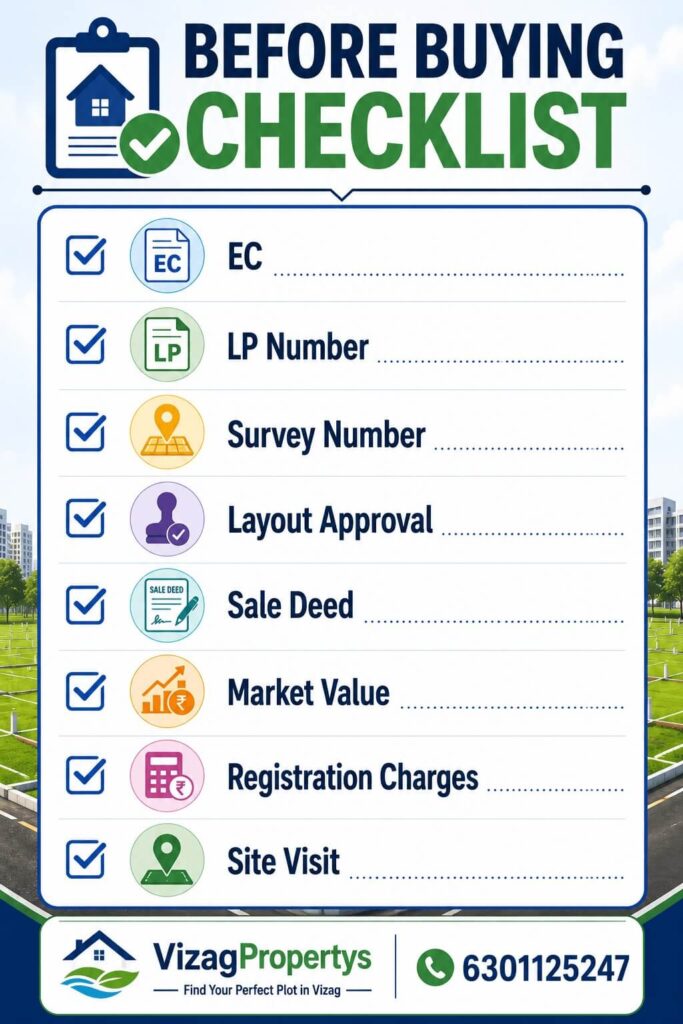
Pre-Registration Checklist for Plot Buyers in Andhra Pradesh
Complete Checklist Before Registering Your Plot
You’ve selected the plot, negotiated the purchase price, reviewed the estimated registration charges, and gathered the necessary documents.
Before you proceed to the Sub-Registrar Office, there is one final step that should never be skipped—a thorough pre-registration review.
Many property-related problems arise not because buyers fail to register the property, but because important checks were overlooked before registration.
A missing document, an incorrect survey number, an unpaid mortgage, or even a spelling mistake in the Sale Deed can lead to unnecessary delays, additional expenses, or future legal complications.
This checklist will help you verify everything before signing the Sale Deed and completing the registration process.
Why a Pre-Registration Checklist Is Important
Property registration is generally the final legal step in purchasing a plot.
Once the Sale Deed is registered, correcting mistakes may require additional procedures, time, and expense.
Taking a little extra time to review every detail beforehand can help you:
- Avoid registration delays.
- Reduce the risk of documentation errors.
- Confirm that the correct property is being transferred.
- Prevent avoidable legal complications.
- Register the property with greater confidence.
Step 1 – Verify the Seller’s Ownership
Before making the final payment or signing the Sale Deed, confirm that the seller has the legal authority to transfer the property.
Check:
- Seller’s identity documents
- Registered ownership documents
- Chain of title (Mother Deed / Link Documents)
- Whether all owners have consented, if there are multiple owners
If the property is owned jointly, ensure that all required parties are involved in the transaction or have provided the necessary legal authorization.
Step 2 – Review the Encumbrance Certificate (EC)
The Encumbrance Certificate is one of the most important documents to review before registration.
It helps buyers understand the registered transactions and encumbrances recorded against the property for the selected search period.
Before proceeding:
- Obtain a recent EC.
- Verify the owner’s details.
- Check that the property description matches the Sale Deed.
- Review any entries that may require clarification.
If anything appears unclear, seek professional advice before moving forward.
Step 3 – Confirm Layout Approval
If you are purchasing a residential plot in a layout, verify that the layout has the necessary approvals from the competent authority.
Check:
- Layout approval details
- LP Number (where applicable)
- Approved layout plan
- Plot number
- Road access
- Open spaces and common areas shown in the approved layout
Never rely solely on brochures or verbal assurances.
Step 4 – Verify the Survey Number and Property Details
Many buyers overlook this step because the property physically appears correct.
However, always verify that the documents match the actual property.
Confirm:
- Survey Number
- Plot Number
- Plot dimensions
- Total area
- Property boundaries
- Orientation (if relevant)
- Access road
The details in the Sale Deed should match the supporting records.
Step 5 – Read the Sale Deed Carefully
Never sign the Sale Deed without reviewing it thoroughly.
Check:
- Buyer name
- Seller name
- Aadhaar details (where applicable)
- PAN details (where applicable)
- Survey Number
- Plot Number
- Plot area
- Sale Consideration
- Property boundaries
- Schedule of the property
- Rights being transferred
If you notice any errors, request corrections before registration.
Step 6 – Confirm the Registration Charges
Before registration, ensure you clearly understand:
- Stamp Duty
- Registration Fee
- Transfer Duty
- Other applicable government charges
- Additional professional or documentation expenses
Knowing the complete financial commitment helps prevent last-minute surprises.
Step 7 – Arrange Your Funds
Don’t plan only for the plot price.
Also budget for:
- Government registration charges
- Advocate fees (if applicable)
- Sale Deed drafting charges
- Verification expenses
- Bank loan-related expenses (if financed)
- Miscellaneous costs
Keeping a financial buffer can also be helpful in case of unforeseen expenses.
Step 8 – Confirm the Registration Appointment
If your registration requires an appointment, verify:
- Date
- Time
- Sub-Registrar Office
- Required documents
- Identity proofs
- Witness availability
Arriving prepared helps avoid unnecessary delays.
Step 9 – Verify Witness Availability
Witnesses play an important role during property registration.
Before registration:
- Confirm that the required witnesses are available.
- Ensure they carry acceptable identity documents.
- Inform them of the registration schedule in advance.
This simple step can help prevent rescheduling.
Step 10 – Keep Original Documents Ready
Prepare a dedicated document folder containing:
- Original Sale Deed (where applicable)
- Identity documents
- PAN Card (where applicable)
- Aadhaar Card
- Photographs (if required)
- Supporting property documents
- Payment receipts
- Appointment details
- Any other required records
Organizing documents beforehand reduces stress on registration day.
Complete Pre-Registration Checklist
Use this checklist before your registration appointment.
| Checklist Item | Status |
|---|---|
| Verified seller's ownership | ☐ |
| Reviewed Encumbrance Certificate | ☐ |
| Confirmed layout approval | ☐ |
| Verified LP Number (where applicable) | ☐ |
| Checked Survey Number | ☐ |
| Confirmed plot boundaries | ☐ |
| Reviewed Sale Deed | ☐ |
| Verified buyer and seller details | ☐ |
| Confirmed registration charges | ☐ |
| Arranged required funds | ☐ |
| Confirmed appointment | ☐ |
| Witnesses informed | ☐ |
| Original documents ready | ☐ |
Common Mistakes Buyers Make Before Registration
Visit the Plot Before Registration
Avoid making the final payment until you’ve completed the necessary document verification and are satisfied with the property’s legal status.
Assuming All Document Details Are Correct
Even professionally prepared documents can contain mistakes.
Always review every important detail yourself.
Ignoring Small Errors
Minor spelling mistakes, incorrect initials, or errors in survey numbers can create unnecessary complications later.
Not Confirming Registration Charges
Budgeting only for the purchase price may lead to financial stress during registration.
Waiting Until the Last Minute
Collecting documents, arranging witnesses, and resolving discrepancies often takes time.
Starting early reduces pressure and allows issues to be addressed before the appointment.
Property Expert Tips
Visit the Plot Before Registration
If possible, visit the property shortly before registration to confirm that it matches the details described in the Sale Deed.
Compare Every Document Together
Cross-check the Survey Number, plot dimensions, boundaries, and owner details across all major documents to ensure consistency.
Keep Digital Copies
Scan all important documents and store them securely in cloud storage or another safe location, in addition to preserving the originals.
Ask Questions Before Signing
If anything is unclear in the Sale Deed or supporting documents, seek clarification before signing.
Understanding the documents before registration is always preferable to resolving issues afterwards.
Frequently Asked Questions
Should I verify the property even if it is in an approved layout?
Yes.
Layout approval is important, but buyers should also verify ownership, title documents, survey details, and other relevant records.
Can registration proceed if a document contains a mistake?
Depending on the nature of the error, corrections may be required before registration. Reviewing documents in advance helps minimize delays.
Is the Encumbrance Certificate enough to confirm ownership?
No.
The EC is an important due diligence document, but it should be reviewed alongside title documents, layout approvals, and other relevant records.
Do I need to visit the plot before registration?
Although not legally mandatory in every case, visiting the property before registration is generally considered a good practice to confirm that the physical property matches the documents.
Key Takeaways
Before registering your plot:
- Verify the seller’s ownership.
- Review the Encumbrance Certificate.
- Confirm layout approvals and LP Number.
- Check the Survey Number, plot dimensions, and boundaries.
- Read the Sale Deed carefully.
- Confirm registration charges and prepare your budget.
- Organize all required documents and ensure your witnesses are ready.
A careful review before registration can save significant time, money, and effort later.
Step-by-Step Property Registration Process in Andhra Pradesh
Complete Registration Process from Booking a Plot to Becoming the Legal Owner
Once you’ve selected the right plot, verified the documents, estimated your registration charges, and completed your pre-registration checks, you’re ready for the final stage of your property purchase—the property registration process.
For many first-time buyers, registration can feel confusing because it involves multiple steps, government procedures, document verification, and legal formalities.
The good news is that once you understand the sequence, the process becomes much easier to follow.
This section explains the registration journey in simple language, helping you understand what happens at each stage, what documents you’ll need, and how to prepare for a smooth registration experience.
Overview of the Registration Process
A typical residential plot registration generally involves the following stages:
- Finalize the property.
- Verify legal documents.
- Agree on the sale consideration.
- Prepare the Sale Deed.
- Estimate and arrange registration charges.
- Complete any required online formalities.
- Schedule the registration appointment (where applicable).
- Visit the Sub-Registrar Office.
- Complete identity and biometric verification.
- Register the Sale Deed.
- Receive the registered document.
- Complete post-registration formalities.
We’ll now look at each step in detail.
Step 1 – Finalize the Property
Before beginning the registration process, ensure that you’ve selected the right property.
Confirm:
- Location.
- Plot size.
- Boundaries.
- Road access.
- Layout approval.
- LP Number (where applicable).
- Survey Number.
- Basic infrastructure.
- Price agreed with the seller.
Never rush this stage simply because you’re eager to complete the purchase.
Step 2 – Verify the Property Documents
This is one of the most important stages of the buying process.
Before registration, review:
- Sale Deed.
- Mother Deed / Link Documents.
- Encumbrance Certificate.
- Layout approval.
- LP Number.
- Survey Number.
- Property tax records (where applicable).
- Seller’s identity documents.
If any document raises questions, resolve them before moving forward.
Step 3 – Negotiate and Confirm the Sale Consideration
Once your due diligence is complete, both parties should agree on:
- Final purchase price.
- Payment terms.
- Registration responsibilities (where agreed).
- Possession timeline.
- Any additional terms and conditions.
These details are generally reflected in the Sale Deed.
Step 4 – Prepare the Sale Deed
The Sale Deed is one of the most important documents in the transaction.
It generally includes:
- Buyer details.
- Seller details.
- Property description.
- Survey Number.
- Plot dimensions.
- Boundaries.
- Sale consideration.
- Rights being transferred.
- Other applicable terms.
Read the document carefully before signing.
Step 5 – Estimate the Registration Charges
Before proceeding to registration, calculate your estimated costs.
This includes:
- Stamp Duty.
- Registration Fee.
- Transfer Duty.
- Other applicable charges.
Preparing your budget in advance helps prevent delays due to insufficient funds.
Step 6 – Arrange the Required Documents
Both parties should organize all necessary documents before the registration appointment.
These commonly include:
Buyer documents
Seller documents
Property documents
Identity proofs
Photographs (where required)
Witness identity documents
Payment receipts (if applicable)
Having everything ready helps the registration process proceed more smoothly.
Step 7 – Complete Online Formalities (Where Applicable)
Depending on the prevailing registration procedures, certain steps may be completed through the IGRS Andhra Pradesh platform or other official systems.
These may include:
- Appointment scheduling.
- Data entry.
- eKYC or identity verification.
- Payment-related processes.
- Status tracking.
The exact online workflow may change over time as government systems are updated.
Step 8 – Visit the Sub-Registrar Office
On the scheduled date, the buyer, seller, and witnesses should arrive at the jurisdictional Sub-Registrar Office with the required documents.
It is advisable to:
- Arrive on time.
- Carry original identity documents.
- Bring all supporting paperwork.
- Keep payment acknowledgements readily available.
- Verify that all parties required for registration are present.
Being well prepared can help avoid unnecessary delays.
Step 9 – Identity Verification and Biometrics
During the registration process, the Registration Department may complete identity verification procedures, which can include:
- Aadhaar-based verification (where applicable).
- Photograph capture.
- Fingerprint or biometric authentication.
- Verification of the parties’ identities.
- Verification of witness identities.
These procedures help confirm that the parties appearing for registration are correctly identified.
Step 10 – Review the Sale Deed One Final Time
Before the document is formally registered, take one final opportunity to review the Sale Deed.
Pay particular attention to:
- Buyer name.
- Seller name.
- Survey Number.
- Plot Number.
- Plot area.
- Boundaries.
- Sale consideration.
- Property schedule.
If you identify any discrepancy, seek clarification before proceeding.
Step 11 – Registration of the Sale Deed
After the required formalities have been completed, the Sale Deed is registered by the Registration Department in accordance with the applicable procedures.
Once registration is completed:
- The transaction becomes part of the official registration records.
- The registered Sale Deed serves as an important legal record of the transfer.
- The buyer can proceed with the subsequent post-registration steps.
Step 12 – Collect the Registered Document
After successful registration, the registered document is made available according to the procedures followed by the Registration Department.
Before leaving:
- Confirm that registration has been completed.
- Preserve any receipts or acknowledgements provided.
- Understand the process for obtaining certified copies, if required in the future.
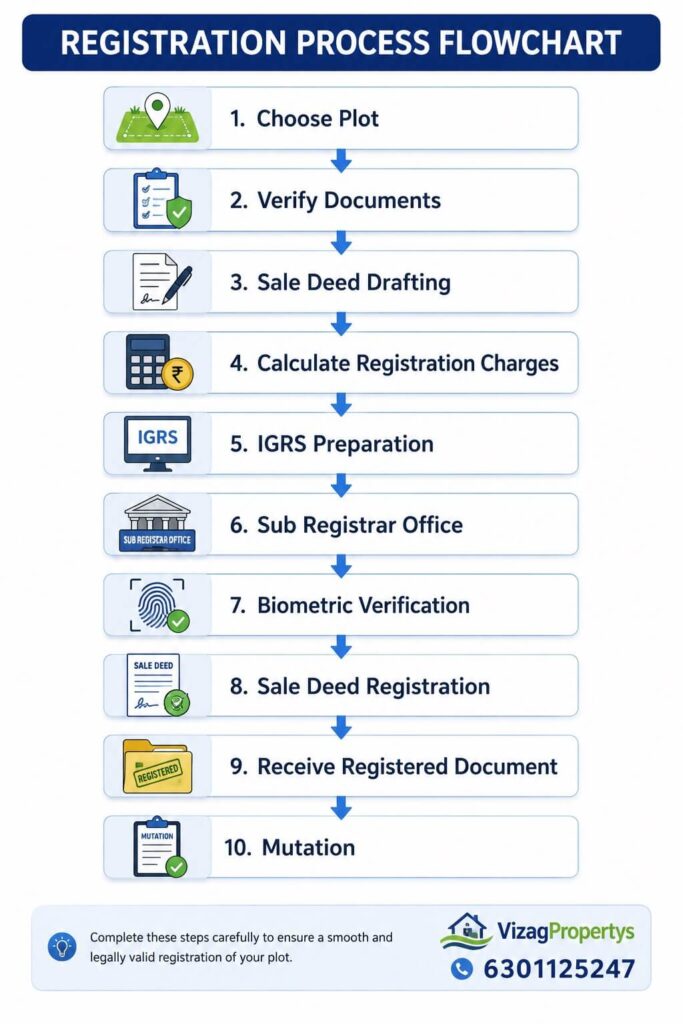
Registration Process Timeline
The overall timeline can vary depending on factors such as document readiness, appointment availability, and transaction-specific requirements.
A typical sequence looks like this:
| Stage | Typical Activity |
|---|---|
| Property Selection | Choose the plot |
| Due Diligence | Verify documents |
| Sale Deed Preparation | Draft and review |
| Registration Charges | Calculate and arrange funds |
| Appointment | Schedule registration |
| Registration Day | Identity verification, execution, and registration |
| Post-Registration | Mutation and record updates |
The exact duration of each stage depends on the individual transaction.
Common Mistakes During Registration
Arriving with Incomplete Documents
Always verify your document checklist before leaving for the Sub-Registrar Office.
Not Reading the Sale Deed Carefully
Never assume the document is error-free.
Review every important detail before signing.
Forgetting Original Identity Documents
Carry all required originals in addition to photocopies, where applicable.
Ignoring Small Errors
Even a minor mistake in a name, survey number, or property description can lead to unnecessary complications.
Arriving Late
Reaching the registration office well before your appointment helps reduce stress and allows time to address any unexpected issues.
Property Expert Tips
Keep All Documents Together
Use a dedicated file folder containing originals, photocopies, receipts, and identification documents.
Verify Every Page Before Signing
Don’t limit your review to the first page of the Sale Deed. Read the entire document, including schedules and annexures.
Ask Questions If Anything Is Unclear
If you don’t understand a clause or notice a discrepancy, seek clarification before completing the registration.
Preserve Every Receipt
Registration-related receipts and acknowledgements may be useful for future administrative or legal purposes.
Frequently Asked Questions
How long does property registration take?
The time required depends on factors such as document readiness, appointment scheduling, and the procedures applicable on the registration date.
Can someone else register the property on my behalf?
Certain transactions may be completed through a legally valid Power of Attorney or other authorized arrangements, subject to the applicable laws and registration requirements.
What happens if a mistake is found after registration?
The appropriate course of action depends on the nature of the mistake. Buyers should seek professional guidance to understand the available legal or administrative remedies.
Can registration be delayed?
Yes.
Delays may occur due to incomplete documentation, discrepancies in records, appointment availability, or other transaction-specific issues.
Preparing thoroughly beforehand helps minimize these risks.
Key Takeaways
The property registration process is much easier when you prepare in advance.
Remember to:
- Verify all documents.
- Confirm the registration charges.
- Prepare the Sale Deed carefully.
- Organize your paperwork.
- Arrive prepared on registration day.
- Review the Sale Deed before signing.
- Preserve all registration records after completion.
Following these steps helps ensure a smoother and more confident property registration experience.
IGRS Andhra Pradesh, Online Registration & Slot Booking
Understanding the IGRS Andhra Pradesh Portal
Technology has made many aspects of property registration more convenient than in the past.
The Integrated Grievance and Registration System (IGRS) is the online platform provided by the Registration & Stamps Department, Government of Andhra Pradesh. It offers various registration-related services, information, and online facilities that help buyers, sellers, legal professionals, and the general public.
While certain stages of the registration process still require a personal visit to the jurisdictional Sub-Registrar Office (SRO), the IGRS portal helps users access important information and complete several preparatory steps online.
Because government services continue to evolve, the exact online facilities available may change over time. Always refer to the official IGRS portal for the latest services and procedures.
What Can Buyers Use the IGRS Portal For?
Depending on the services available at the time, buyers may be able to use the portal for activities such as:
- Viewing registration-related information.
- Checking Government Market Values.
- Accessing certain Encumbrance Certificate services.
- Calculating applicable stamp duty and registration charges.
- Viewing office details.
- Accessing public registration information.
- Scheduling appointments or completing online registration-related formalities, where available.
The availability of individual services may vary based on government updates and the nature of the transaction.
Why the IGRS Portal Is Useful
The IGRS portal helps buyers prepare before visiting the Sub-Registrar Office.
Some of the benefits include:
- Better understanding of registration requirements.
- Easier access to official information.
- Reduced dependence on unofficial sources.
- Improved planning before registration.
- Greater transparency in the registration process.
Using official government resources can help buyers make better-informed decisions.
Online Slot Booking
For certain registration-related services, an appointment or slot booking may be available or required through the official registration system.
Where applicable, booking an appointment in advance can help:
- Reduce waiting time.
- Improve scheduling.
- Ensure that the necessary parties are available.
- Streamline the registration process.
Because appointment procedures may change, always follow the latest instructions issued by the Registration & Stamps Department.
Preparing Before Booking an Appointment
Before scheduling your registration, make sure you have:
- Finalized the property.
- Verified the documents.
- Reviewed the Sale Deed.
- Estimated the registration charges.
- Arranged the required funds.
- Confirmed witness availability.
Completing these steps beforehand helps avoid unnecessary rescheduling.
eKYC and Identity Verification
As part of the registration process, identity verification may include electronic Know Your Customer (eKYC) procedures where applicable.
Depending on the prevailing registration system, this may involve:
- Identity verification using approved documents.
- Aadhaar-based authentication, where applicable and permitted.
- Verification of buyer and seller details.
- Verification of witness identities.
The exact eKYC process may vary depending on government procedures in force at the time of registration.
Biometric Verification
To strengthen the integrity of property registration, biometric verification is commonly used during the registration process.
Depending on the applicable procedures, this may include:
- Fingerprint authentication.
- Photograph capture.
- Identity confirmation of the parties.
- Identity confirmation of witnesses.
These measures help ensure that the persons executing the Sale Deed are correctly identified.
Documents to Keep Ready Before Your Appointment
To avoid unnecessary delays, organize all required documents before leaving for the Sub-Registrar Office.
A typical document folder may include:
- Sale Deed.
- Identity documents.
- Aadhaar Card.
- PAN Card (where applicable).
- Property documents.
- Encumbrance Certificate.
- Layout approval documents.
- LP Number details (where applicable).
- Photographs (if required).
- Payment receipts.
- Appointment confirmation (where applicable).
Preparing these documents in advance contributes to a smoother registration experience.
What Happens After Online Formalities?
Completing online steps does not usually mean that the registration process is finished.
For many property transactions, the parties are still required to appear before the jurisdictional Sub-Registrar Office to complete the remaining legal formalities, including identity verification, execution of the Sale Deed, and registration of the document.
Always follow the instructions applicable to your specific transaction.
Common Mistakes When Using Online Registration Services
Depending on Unofficial Websites
Always use the official Andhra Pradesh Registration & Stamps portal for registration-related information and services.
Waiting Until the Last Minute
Don’t postpone online preparations until the day before registration.
Complete them well in advance so that any issues can be resolved without delaying your appointment.
Entering Incorrect Information
Small mistakes in names, survey numbers, Aadhaar details, or property information can lead to delays.
Review all information carefully before submission.
Assuming Online Formalities Replace Physical Registration
For many transactions, online services assist with the registration process but do not eliminate the need to complete the legal formalities before the Sub-Registrar.
Property Expert Tips
Use Only Official Government Information
When checking registration charges, Government Market Value, or registration procedures, rely on the official Registration & Stamps Department rather than unverified third-party sources.
Complete Preparations Before Booking
Scheduling an appointment before your documents are ready can lead to unnecessary inconvenience.
Finish your due diligence first.
Save Digital Copies
Keep scanned copies of your important documents and appointment details for easy access.
Verify Details Before Submission
Whether completing online forms or reviewing the Sale Deed, double-check names, survey numbers, plot dimensions, and other important information before proceeding.
Frequently Asked Questions
Can I complete the entire property registration online?
For many standard property transactions, online services help with preparation and certain procedural steps, but personal appearance before the Sub-Registrar Office is generally required to complete the registration process.
Is online slot booking compulsory?
Appointment requirements may vary depending on the prevailing registration procedures and the nature of the transaction. Always verify the latest process before registration.
What if I make a mistake while entering information online?
If you identify an error, seek guidance before completing the registration process so that it can be corrected according to the applicable procedures.
Can I check Government Market Value online?
The IGRS portal provides official valuation-related services. Buyers should use the latest official facilities available through the Registration & Stamps Department.
Key Takeaways
- The IGRS Andhra Pradesh portal provides official registration-related information and services.
- Online facilities can help buyers prepare before visiting the Sub-Registrar Office.
- Complete your document verification and financial planning before scheduling your appointment.
- Identity verification and biometric procedures remain an important part of the registration process.
- Always rely on official government resources for the latest procedures and information.
What Happens on Registration Day? (Sub-Registrar Office Procedure)
A Complete Guide to Property Registration Day in Andhra Pradesh
For many buyers, registration day is both exciting and a little stressful.
After weeks of searching for the right plot, verifying documents, negotiating the purchase price, estimating registration charges, and preparing paperwork, the final legal step is to register the Sale Deed at the jurisdictional Sub-Registrar Office (SRO).
If this is your first property purchase, you may be wondering what actually happens once you reach the registration office.
The good news is that if you’ve completed your preparation properly, registration day is generally straightforward.
This section explains the process from the moment you arrive at the Sub-Registrar Office until the Sale Deed is successfully registered.
Before Leaving Home
A smooth registration day begins before you even reach the registration office.
Before leaving, make sure you have:
- Original identity documents
- Property documents
- Sale Deed
- Registration payment details (where applicable)
- Appointment confirmation (if applicable)
- Witnesses
- Mobile phone
- Copies of important documents
Keeping everything together in one folder helps avoid unnecessary stress.
Arriving at the Sub-Registrar Office
Try to arrive before your scheduled appointment.
This provides enough time to:
- Locate the correct office or counter.
- Meet the seller.
- Meet your witnesses.
- Organize documents.
- Resolve any minor issues before the registration process begins.
Arriving early is especially helpful if the office is busy.
Document Verification
Before the Sale Deed is registered, the documents are generally reviewed to ensure that the registration requirements have been met.
The verification process may include checking:
- Buyer details.
- Seller details.
- Property description.
- Survey Number.
- Plot Number.
- Sale consideration.
- Identity documents.
- Supporting records.
If any discrepancy is identified, clarification or corrections may be required before the registration can proceed.
Identity Verification
The identities of the parties involved are generally verified as part of the registration process.
Depending on the applicable procedures, this may involve:
- Aadhaar-based verification (where applicable).
- Verification of identity documents.
- Photograph capture.
- Confirmation of personal details.
Identity verification helps ensure that the persons executing the document are correctly identified.
Biometric Authentication
Biometric verification is an important part of many property registrations.
Depending on the prevailing registration procedures, this may include:
- Fingerprint capture.
- Photograph capture.
- Digital identity verification.
These measures contribute to the integrity of the registration process and help reduce the risk of impersonation.
Witness Verification
Witnesses play an important role in the execution of the Sale Deed.
They may be required to:
- Present acceptable identity documents.
- Confirm their identity.
- Sign the required documents.
- Complete any applicable verification procedures.
Before registration day, make sure your witnesses understand the appointment schedule and arrive on time.
Execution of the Sale Deed
Once the required verification procedures have been completed, the Sale Deed is executed according to the applicable legal procedures.
Before signing:
Read the document carefully one final time.
Pay special attention to:
- Buyer’s name.
- Seller’s name.
- Survey Number.
- Plot Number.
- Plot area.
- Boundaries.
- Sale consideration.
- Property schedule.
Never hesitate to ask questions if any part of the document is unclear.
Registration of the Document
After all legal formalities have been completed, the Registration Department registers the Sale Deed.
This officially records the transaction in the government registration records.
Once registered, the Sale Deed becomes an important legal document evidencing the transfer of ownership.
Receiving Registration Acknowledgement
After registration, the Registration Department will follow its prescribed procedure for providing acknowledgements and making the registered document available.
Before leaving the office:
- Confirm that the registration has been completed.
- Collect any receipts or acknowledgements issued.
- Understand the procedure for obtaining certified copies if needed in the future.
How Long Does Registration Day Usually Take?
The time required can vary depending on:
- Number of registrations scheduled that day.
- Completeness of documents.
- Identity verification.
- Appointment timing.
- Office workload.
- Transaction complexity.
Simple, well-prepared transactions generally take less time than those requiring additional verification or corrections.
Registration Day Checklist
Use this checklist before leaving for the Sub-Registrar Office.
| Item | Ready |
|---|---|
| Aadhaar Card | ☐ |
| PAN Card (where applicable) | ☐ |
| Sale Deed | ☐ |
| Property documents | ☐ |
| Encumbrance Certificate | ☐ |
| Layout approval documents | ☐ |
| Payment receipts | ☐ |
| Witnesses | ☐ |
| Mobile phone | ☐ |
| Appointment details | ☐ |
Common Mistakes on Registration Day
Arriving Late
Late arrival may cause unnecessary inconvenience or require rescheduling in certain situations.
Forgetting Original Documents
Photocopies alone may not be sufficient where originals are required for verification.
Not Bringing Witnesses
If witnesses are required for your transaction, ensure they are available and carry valid identity documents.
Signing Without Reading
Never sign the Sale Deed without carefully reviewing all important details.
Ignoring Small Errors
Even minor mistakes in names, initials, survey numbers, or property descriptions should be addressed before the registration is completed.
Property Expert Tips
Keep Calm
Registration day is an administrative process.
If you’ve completed your preparation properly, there is usually no reason to feel anxious.
Carry Extra Copies
Although originals are important, carrying photocopies of key documents can be useful if additional copies are requested.
Dress Comfortably
Registration appointments may involve waiting for some time.
Comfortable clothing and proper preparation can make the experience easier.
Stay Until Everything Is Complete
Don’t leave the Sub-Registrar Office until you’ve confirmed that all required formalities have been completed and you’ve received the necessary acknowledgements or instructions.
Frequently Asked Questions
Do both the buyer and seller need to be present?
For many standard Sale Deed registrations, the parties are generally required to appear in accordance with the applicable legal procedures. Certain transactions may be completed through legally authorized representatives where permitted by law.
Are fingerprints compulsory?
Biometric procedures depend on the prevailing registration system and applicable rules.
Can registration be completed in one day?
Many straightforward residential property registrations are completed on the scheduled day, provided the documents are in order and all required formalities are fulfilled.
What should I do if I notice a mistake before signing?
Bring it to the attention of the concerned parties immediately and seek correction before the document is executed and registered.
Key Takeaways
Registration day is the culmination of your property purchase journey.
To ensure a smooth experience:
- Arrive on time.
- Carry all original documents.
- Bring your witnesses.
- Review the Sale Deed carefully.
- Complete identity and biometric verification.
- Confirm that the registration has been completed before leaving the office.
Good preparation is the key to a successful registration.
What to Do After Property Registration in Andhra Pradesh
Important Steps to Complete After Registering Your Plot
Congratulations!
Once your Sale Deed has been successfully registered, you’ve completed one of the most important legal steps in purchasing your plot.
However, many first-time buyers make the mistake of believing that the registration process ends here.
In reality, there are several important post-registration activities that help you protect your ownership records, keep your property documents organized, and make future transactions much easier.
Completing these steps now can save considerable time, effort, and inconvenience in the years ahead.
Step 1 – Collect and Verify the Registered Sale Deed
After the registration process is completed, make sure you receive the registered Sale Deed or follow the prescribed procedure for obtaining it, depending on the system followed by the Registration & Stamps Department.
Once you receive the document:
Carefully verify:
- Buyer’s name
- Seller’s name
- Survey Number
- Plot Number
- Plot dimensions
- Boundaries
- Property schedule
- Registration details
If you notice any discrepancy, seek clarification as early as possible.
Step 2 – Apply for Mutation (Patta Transfer)
One of the most commonly overlooked post-registration tasks is Mutation.
Mutation is the process of updating the relevant revenue or local authority records to reflect the change in ownership after the property has been transferred.
Although the registered Sale Deed establishes the transfer of ownership, mutation helps ensure that the relevant property records are updated in the buyer’s name according to the applicable procedures.
Depending on the nature and location of the property, the authority responsible for mutation may differ.
Why Mutation Is Important
Updating property records can help with:
- Future resale.
- Property tax administration.
- Revenue records.
- Ownership-related administrative processes.
- Maintaining accurate government records.
Registration and mutation are different procedures, and buyers should understand that one does not automatically replace the other in every situation.
Step 3 – Update Property Tax Records (Where Applicable)
If property tax records apply to your property, they should be updated according to the procedures of the relevant local authority.
Keeping tax records current helps:
- Maintain accurate ownership records.
- Avoid future administrative issues.
- Simplify future property transactions.
The exact procedure depends on the jurisdiction in which the property is located.
Step 4 – Organize Your Property Documents
After registration, create a dedicated file containing all important property records.
This should include:
- Registered Sale Deed.
- Encumbrance Certificate.
- Mother Deed / Link Documents (copies, where available).
- Layout approval documents.
- LP Number details (where applicable).
- Registration receipts.
- Tax receipts.
- Payment acknowledgements.
- Property-related correspondence.
Maintaining an organized record can be extremely helpful in the future.
Step 5 – Create Digital Backups
Original documents are valuable.
However, they should never be your only copy.
Scan important documents and store digital copies securely.
Recommended storage options include:
- Password-protected computer.
- External hard drive.
- Secure cloud storage.
- Encrypted USB drive.
Having digital copies can make future verification, financing, or resale much easier.
Step 6 – Store Original Documents Safely
Your original registered Sale Deed is one of your most important legal documents.
Store it in a safe place such as:
- Home locker.
- Bank locker.
- Fire-resistant document safe.
Avoid carrying original documents unnecessarily unless required for official purposes.
Step 7 – Keep Every Registration Receipt
Don’t discard:
- Registration receipts.
- Payment acknowledgements.
- Fee receipts.
- Appointment records.
- Certified copies.
These documents may prove useful in future administrative or legal situations.
Step 8 – Continue Monitoring Your Property Records
Property ownership is a long-term responsibility.
Periodically review your records and ensure that all important property documents remain safely preserved and up to date.
If you later:
- sell the property,
- apply for a loan,
- transfer ownership,
- or undertake legal documentation,
having organized records can save significant time.
Post-Registration Checklist
Use this checklist after completing registration.
| Task | Status |
|---|---|
| Registered Sale Deed received | ☐ |
| Sale Deed verified | ☐ |
| Mutation applied for (where applicable) | ☐ |
| Property tax records updated (where applicable) | ☐ |
| Original documents stored safely | ☐ |
| Digital copies created | ☐ |
| Registration receipts preserved | ☐ |
| Property file organized | ☐ |
Common Mistakes After Registration
Not Applying for Mutation
Many buyers mistakenly assume that registration automatically updates all government records.
Depending on the property and applicable procedures, additional steps such as mutation may still be required.
Losing the Original Sale Deed
Replacing important documents can be difficult.
Store originals safely and avoid unnecessary handling.
Not Creating Digital Copies
Digital backups provide an additional layer of protection if the originals are damaged or misplaced.
Mixing Property Documents with Personal Papers
Maintain a dedicated property file for easier retrieval in the future.
Ignoring Future Record Updates
If your address, ownership details, or other relevant records require updating in the future, complete those procedures promptly according to the applicable rules.
Property Expert Tips
Create a Property File
Keep every document related to the property in a single well-organized folder.
This habit can save hours of searching in the future.
Scan Documents Immediately
Don’t postpone creating digital backups.
Scan the documents as soon as you receive them.
Review Your Records Periodically
Every few years, review your property records to ensure everything remains complete and safely stored.
Preserve Even Small Receipts
Minor receipts often become important during future resale, financing, or administrative procedures.
Frequently Asked Questions
Is registration the final step after buying a plot?
Registration is a major legal milestone, but buyers should also complete post-registration tasks such as mutation and maintaining their property records, where applicable.
Why is mutation important?
Mutation helps update the relevant government records to reflect the change in ownership. It serves a different administrative purpose from property registration.
Should I laminate my Sale Deed?
Avoid laminating original property documents unless specifically advised, as lamination may interfere with certain document handling or authentication processes. Store the document in a protective folder instead.
How long should I keep my property documents?
Property documents should generally be preserved for as long as you own the property, and often even after a subsequent transfer, depending on your legal and financial record-keeping needs.
Key Takeaways
After registering your plot:
- Verify the registered Sale Deed.
- Complete mutation, where applicable.
- Update relevant property records and tax records.
- Organize all property documents.
- Create secure digital backups.
- Preserve original documents carefully.
- Keep every registration-related receipt.
Good record management today can make future resale, financing, inheritance, or legal verification much simpler.
Frequently Asked Questions (FAQs) About Plot Registration Charges in Andhra Pradesh
The following questions are among the most common concerns raised by buyers planning to purchase a residential plot in Andhra Pradesh.
While these answers provide general guidance, registration charges and procedures may change over time. Always verify the latest requirements through the Registration & Stamps Department, Government of Andhra Pradesh, or seek professional advice where necessary.
Registration Charges
- What are plot registration charges in Andhra Pradesh?
Plot registration charges generally include statutory government charges associated with registering the Sale Deed, such as:
- Stamp Duty
- Registration Fee
- Transfer Duty (where applicable)
The total amount payable depends on the nature of the transaction, the applicable calculation basis, and the prevailing government rates.
- How are registration charges calculated?
For many standard residential plot Sale Deed registrations, statutory charges are generally calculated using the higher of the Sale Consideration or the Government Market Value, subject to the applicable laws and government notifications.
- Are registration charges included in the plot price?
Usually, no.
Unless specifically stated in writing, the quoted plot price generally does not include statutory government registration charges.
Always confirm this with the seller or developer before making any payment.
- Can registration charges change?
Yes.
The Government may revise applicable rates, concessions, or procedures through official notifications.
Always verify the latest position before registration.
- Can I estimate my registration cost before buying?
Yes.
You can estimate your registration budget using the applicable property value and the prevailing statutory rates.
However, the final amount should always be confirmed before registration.
Stamp Duty
- What is Stamp Duty?
Stamp Duty is a statutory government levy payable on certain property transactions and is generally one of the largest components of the total registration charges.
- Is Stamp Duty refundable?
Refund eligibility depends on the applicable legal provisions and the specific circumstances of the transaction.
Consult the Registration Department or a qualified legal professional if this situation arises.
- Is Stamp Duty different from the Registration Fee?
Yes.
Stamp Duty is a statutory levy on the transaction, while the Registration Fee is charged for officially registering the document.
- Is Stamp Duty calculated on the sale price?
For many standard residential Sale Deed registrations, the calculation is generally based on the higher of the Sale Consideration or the Government Market Value, subject to the applicable rules.
Registration Fee
- What is the Registration Fee?
The Registration Fee is the charge collected for officially registering the Sale Deed and recording it in the government registration records.
- Is the Registration Fee compulsory?
For a standard Sale Deed registration, the applicable Registration Fee forms part of the statutory charges associated with the registration process.
Transfer Duty
- What is Transfer Duty?
Transfer Duty is a separate statutory component that may apply to certain property registrations under the applicable legal framework.
- Is Transfer Duty included in Stamp Duty?
No.
These are separate statutory charges collected for different purposes.
Government Market Value
- What is the Government Market Value?
It is the value maintained by the Registration & Stamps Department for registration purposes.
It may differ from the negotiated purchase price.
- What is Guideline Value?
In everyday usage, buyers often use Government Market Value and Guideline Value interchangeably.
It refers to the value used for registration-related valuation purposes.
- Which value is used for calculating registration charges?
For many standard residential Sale Deed registrations, the applicable calculation is generally based on the higher of the Sale Consideration or the Government Market Value, subject to the applicable laws and rules.
Documents
- Which documents are required for registration?
Typical documents include:
- Sale Deed
- Aadhaar
- PAN (where applicable)
- Encumbrance Certificate
- Identity documents
- Property documents
- Layout approval records
- Other supporting documents, depending on the transaction
- Why is the Encumbrance Certificate important?
The EC helps buyers review registered transactions and encumbrances affecting the property during the selected search period.
- Why is the LP Number important?
For approved layouts, the LP Number helps identify and verify the approved layout details.
- Should I verify the Survey Number?
Absolutely.
Always ensure that the Survey Number in the Sale Deed matches the relevant property records.
Registration Process
- Can property registration be completed online?
Certain preparatory steps may be completed online through the IGRS portal, but many standard property registrations still require personal appearance before the Sub-Registrar Office.
- What is IGRS Andhra Pradesh?
IGRS is the official online platform of the Registration & Stamps Department that provides various registration-related services and information.
- What is eKYC?
eKYC is an electronic identity verification process that may be used during registration where applicable.
- Why are biometrics collected?
Biometric verification helps confirm the identities of the parties involved in the property transaction.
- Are witnesses required?
Many standard Sale Deed registrations require witnesses in accordance with the applicable legal procedures.
Registration Day
- How long does registration take?
The time varies depending on the documents, appointment schedule, office workload, and transaction complexity.
- What should I carry on registration day?
Carry:
- Identity documents
- Sale Deed
- Property documents
- Payment records
- Appointment details (where applicable)
- Witnesses
- Supporting documents
- Should I read the Sale Deed before signing?
Yes.
Review every page carefully and ensure that all important details are accurate.
After Registration
- What is Mutation?
Mutation is the process of updating the relevant revenue or local authority records after the transfer of ownership.
- Is Mutation compulsory?
The requirements depend on the applicable laws and the authority responsible for maintaining the records.
However, buyers should understand that registration and mutation are different procedures.
- Should I update property tax records?
Where applicable, updating property tax records helps maintain accurate ownership information with the relevant local authority.
- How should I store my Sale Deed?
Store the original document in a safe location, such as a home locker or bank locker, and maintain secure digital backups.
Buying a Plot
- Should I verify documents before paying?
Yes.
Document verification should ideally be completed before making the final payment and proceeding with registration.
- Should I visit the plot before registration?
It is generally considered a good practice to visit the property and confirm that it matches the details recorded in the documents.
- Should I hire a property lawyer?
Complex transactions or situations involving legal uncertainty may benefit from professional legal advice.
VMRDA-Approved Plots
- Are registration charges different for VMRDA-approved plots?
The statutory registration charges generally depend on the applicable laws, document type, and calculation basis rather than the marketing description of the layout. However, buyers should verify all approvals and transaction-specific details before registration.
- Why should I verify VMRDA approval?
Layout approval verification is an important part of property due diligence and helps buyers confirm that the layout has the necessary approvals from the competent authority.
NRI Buyers
- Can an NRI purchase a residential plot in Andhra Pradesh?
NRI purchases are subject to the applicable laws, regulations, and RBI/FEMA provisions. Buyers should seek professional advice where required.
- Can an NRI register property through a Power of Attorney?
Certain transactions may be completed through a legally valid Power of Attorney, subject to the applicable laws and registration requirements.
Miscellaneous
- Can I correct mistakes after registration?
The available remedies depend on the nature of the error and the applicable legal procedures. Seek legal advice if corrections are required.
- Can registration be cancelled?
Cancellation of a registered document is a legal matter that depends on the applicable laws, judicial decisions, and the facts of each case.
- Can I sell my plot immediately after registration?
The ability to sell a property depends on the legal status of the property, the applicable laws, and any contractual or statutory restrictions.
- Is a registered Sale Deed enough to prove ownership?
A registered Sale Deed is an important legal document evidencing the transfer of ownership. Depending on the situation, other documents and records may also be relevant.
- Why should I keep all property documents safely?
Organized records make future resale, financing, mutation, inheritance, and legal verification much easier.
- Where can I verify the latest registration charges?
Always refer to the official Andhra Pradesh Registration & Stamps Department or the official IGRS Andhra Pradesh portal for the latest rates, procedures, and notifications.
Still Have Questions?
Every property transaction is unique.
The exact registration charges, applicable documents, and legal requirements can vary depending on the property’s location, document type, ownership history, and the prevailing government rules.
If you’re planning to purchase a VMRDA-approved plot in or around Visakhapatnam and would like guidance on estimating your registration cost or understanding the documentation involved, the VizagPropertys team will be happy to assist you with general information and help you understand the buying process.
Related Guides on VizagPropertys
For a deeper understanding of the property buying journey, we recommend reading:
- VMRDA Approved Plots in Vizag
- VUDA Approved Plots in Vizag
- Plots in Vizag
- LP Number Explained – Complete Guide
- Encumbrance Certificate (EC) Guide
- Bhogapuram International Airport – Complete Guide
- Why Invest in Vizag Real Estate?
- Mortgage Plots in VUDA/VMRDA Approved Layouts
- BBG Beverly Hills Investment Guide
- How to Buy VMRDA-Approved Plots in Vizag Guide
Common Registration Mistakes & Expert Tips for Plot Buyers in Andhra Pradesh
Avoid These Costly Mistakes Before Registering Your Plot
Buying a plot is one of the biggest financial decisions most people make.
By the time you reach registration day, you’ve already invested time, money, and effort into selecting the property, verifying documents, arranging funds, and preparing the Sale Deed.
Unfortunately, many buyers still make avoidable mistakes that can delay registration, increase costs, or create problems in the future.
The good news is that most of these mistakes can be prevented with proper planning and careful verification.
This section highlights some of the most common issues seen during property purchases and explains how you can avoid them.
Mistake 1 – Not Verifying the Property Title
One of the biggest mistakes buyers make is assuming that the seller has a clear and marketable title without independently verifying the ownership history.
Before registration:
- Review the chain of title.
- Examine the Mother Deed and Link Documents.
- Verify that the seller has the legal authority to transfer the property.
- Seek legal advice if anything appears unclear.
Title verification should always be completed before making the final payment or proceeding with registration.
Mistake 2 – Ignoring the Encumbrance Certificate
Some buyers assume that because a property looks genuine, there is no need to review the Encumbrance Certificate (EC).
The EC is an important due diligence document because it helps identify registered transactions and encumbrances affecting the property during the selected search period. However, it should not be treated as the only document for deciding whether to purchase a property. Comprehensive due diligence is still necessary.
Always:
- Obtain a recent EC.
- Verify the property details carefully.
- Cross-check the EC with the Sale Deed and other title documents.
Mistake 3 – Not Checking Layout Approval
If you’re buying a residential plot in a layout, always verify that it has been approved by the competent authority.
For buyers interested in VMRDA-approved plots around Visakhapatnam, this means confirming that the layout approval details and LP Number (where applicable) match the property being purchased.
Never rely only on:
- Advertisements
- Brochures
- Social media posts
- Verbal assurances
Verify the approval documents yourself before registration.
Mistake 4 – Assuming the Advertised Price Is the Final Cost
Many first-time buyers calculate only the purchase price of the plot.
However, the total acquisition cost generally includes:
- Plot price
- Stamp Duty
- Registration Fee
- Transfer Duty (where applicable)
- Legal documentation
- Sale Deed drafting
- Property verification
- Other incidental expenses
Preparing a complete budget in advance helps avoid financial stress during registration.
Mistake 5 – Not Understanding Government Market Value
A common misconception is that registration charges are always calculated on the negotiated purchase price.
For many standard residential Sale Deed registrations in Andhra Pradesh, statutory charges are generally calculated on the higher of the Sale Consideration or the Government Market Value, subject to applicable laws and government notifications.
Understanding this principle before buying helps you estimate your registration budget more accurately.
Mistake 6 – Signing Without Reading the Sale Deed
Never assume that every detail in the Sale Deed is correct.
Before signing, verify:
- Buyer’s name
- Seller’s name
- Survey Number
- Plot Number
- Plot dimensions
- Boundaries
- Sale Consideration
- Schedule of Property
Correcting mistakes before registration is generally much easier than addressing them afterwards.
Mistake 7 – Depending Only on Verbal Promises
Property purchases should always be based on properly verified documents rather than verbal assurances.
If someone says:
- “Approval will come later.”
- “The documents are somewhere else.”
- “Registration can be corrected later.”
Request documentary evidence before proceeding.
Written records provide greater clarity than verbal statements.
Mistake 8 – Not Visiting the Property
Even if you’ve seen photographs or videos, visit the plot before registration whenever possible.
Confirm:
- Plot location.
- Access road.
- Boundaries.
- Neighbouring properties.
- Physical condition.
- Whether the site matches the approved layout and documents.
A site visit can often identify issues that are not obvious from paperwork alone.
Mistake 9 – Forgetting Mutation After Registration
Many buyers believe that once the Sale Deed is registered, every government record is automatically updated.
Registration and mutation generally serve different purposes, and buyers should understand whether they need to apply separately for updating the relevant revenue or local authority records after registration.
Mistake 10 – Losing Important Property Documents
Your registered Sale Deed is one of your most valuable legal documents.
After registration:
- Store the original safely.
- Create digital backups.
- Preserve payment receipts.
- Organize all property records in one dedicated file.
Good document management makes future resale, financing, and legal verification much easier.
Expert Tips for First-Time Plot Buyers
Verify Before You Pay
Complete your due diligence before making the final payment.
Don’t allow registration deadlines to pressure you into skipping important verification steps.
Budget Beyond the Plot Price
Your budget should include:
- Purchase price
- Registration charges
- Legal fees
- Documentation expenses
- A contingency amount for unexpected costs
A realistic budget helps avoid last-minute financial difficulties.
Keep Written Records
Maintain copies of:
- Payment receipts
- Sale Agreement (if executed)
- Sale Deed
- Registration receipts
- Email and written correspondence
These records may be useful if questions arise later.
Work With Reputable Professionals
If you’re unsure about any aspect of the transaction, consult:
- A qualified property lawyer.
- A licensed document writer.
- A trusted real estate professional.
Professional guidance can help identify issues before they become expensive problems.
Never Rush Registration
A genuine property transaction should withstand careful scrutiny.
If you’re being pressured to skip document verification or sign immediately, take time to review the documents carefully, seek independent legal advice if necessary, and proceed only when you are satisfied that the property’s ownership and paperwork are in order.
Golden Rules for Safe Property Registration
Before registering any plot, remember these ten rules:
- Verify the seller’s ownership.
- Review the Encumbrance Certificate.
- Confirm layout approval.
- Verify the LP Number (where applicable).
- Check the Survey Number and boundaries.
- Understand your registration charges.
- Read the Sale Deed carefully.
- Visit the property before registration.
- Preserve all documents after registration.
- Complete mutation and other post-registration formalities where applicable.
Following these practices can significantly reduce the risk of avoidable problems during or after the purchase.
Property Expert Advice from VizagPropertys
At VizagPropertys, we believe an informed buyer makes better decisions.
That is why we encourage every buyer to:
- Understand the complete registration process.
- Verify property documents carefully.
- Estimate the total acquisition cost before booking.
- Visit the property personally whenever possible.
- Ask questions whenever something is unclear.
Our goal is not simply to help you buy a plot—it is to help you purchase with confidence and make informed decisions throughout the process.
Key Takeaways
Before registering your plot, remember:
- Never skip document verification.
- Understand every component of the registration charges.
- Don’t rely solely on verbal assurances.
- Read the Sale Deed carefully.
- Budget for the complete cost of acquisition.
- Keep all property records organized after registration.
- Complete any applicable post-registration formalities.
Following these simple practices can help make your property purchase smoother, safer, and better documented.
Final Thoughts
After reading this guide, you should now have a much clearer understanding of plot registration charges in Andhra Pradesh, how they are calculated, and what to expect before, during, and after registration.
Buying a plot is much more than finding a good location or negotiating the right price. It also involves understanding government charges, verifying property documents, completing legal formalities, and planning your budget carefully.
Whether you’re a first-time buyer, an investor, an NRI, or someone planning to build a home in the future, taking the time to understand the registration process can help you avoid costly mistakes and make better-informed decisions.
Remember these key points before purchasing any plot:
- Verify the property’s ownership and title.
- Review the Encumbrance Certificate (EC).
- Confirm the layout approval and LP Number, where applicable.
- Understand the Government Market Value.
- Estimate your registration charges before making the final payment.
- Read the Sale Deed carefully before signing.
- Complete post-registration formalities such as mutation, where applicable.
- Preserve all original property documents safely.
A well-informed buyer is far less likely to encounter avoidable legal or financial problems.
We hope this guide has helped you understand not only the registration charges but also the complete property registration journey in Andhra Pradesh.
As government rules, registration charges, and procedures may change from time to time, always verify the latest applicable rates and requirements through the official Registration & Stamps Department before completing your transaction.
Ready to Buy a VMRDA-Approved Plot in Vizag?
If you’re planning to purchase a VMRDA-approved plot in or around Visakhapatnam, we’re here to help you make an informed decision.
At VizagPropertys, we believe buyers deserve transparent information before investing their hard-earned money. We can assist you with:
- Genuine VMRDA-approved plot options
- Guidance on registration charges and the buying process
- Basic document guidance and due diligence
- Information about project locations and infrastructure
- Free site visit assistance
- Transparent pricing and project details
Whether you’re buying your first plot, investing for the future, or planning to build your dream home, our goal is to help you move forward with confidence.
Book your FREE site visit today and explore verified VMRDA-approved plots with confidence.
Explore Plots by Location
Explore these locations and projects from VizagPropertys to make well-informed decisions when buying VMRDA-approved plots in and around Vizag.